Wednesday, August 01, 2007

Day of the Puerto Rican Indian


Did You Know - The official “Day of the Puerto Rican Indian” was inaugurated in a State Proclamation of the Interim Governor of the Commonwealth of Puerto Rico, the Hon. Fernando Chardón, on the 12th day of August 1970. Recently, the autonomous municipality of Jayuya (Office of Tourism) in cooperation with local Taino represented with a community organization called CATTA-COOP Inc. has celebrated this day with a weekend of special presentations and programs entitled "La Jornada Indigena". - UCTP Taino News © 2007

Monday, July 02, 2007

Baseball

Did You Know - Baseball as sport has its origins in the Taino batu game played in Cuba and throughout the Caribbean. Spanish chroniclers who traveled to the islands during the conquest and colonization periods provide evidence of this activity. The batu game was played at the batei/batey (ball field/court/ceremonial ground) and players used a ball made of resin and shaped leaves. As recorded in Cuba, in some cases, this ball was hit with an instrument similar to an oar or spade. According to Cuban linguists there is a relation in the origin of the words bate (bat) and batear (hit) with the corresponding words batey and batu used by the Tainos. – UCTP Taino News © 2007

See also:

Thursday, June 14, 2007

Mabodamaka

Did You Know - Kasike Mabodomaka was one of the Taíno leaders during the 16th century Indian Wars in Boriken (Puerto Rico). Mabodomaka’s Iukaieke (territory) extended through the present day pueblos of Camuy, Quebradillas, and Isabela. Before the European invasion this area was known as guahataka (Taíno for "The Water Ladle"). Local oral history states that when his warriors could no longer hold back the European invaders he led his people up the Guajataca River and disappeared into the Island's central mountain range. Route # 113 (Quebradillas - Isabela) has been renamed "Avenida Cacíque Mabodomaca" in honor of this great Kasike (Chieftain). UCTP Taino News © 2007

Friday, May 25, 2007

Chico Spring: Taino Waterhole*

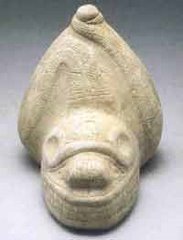
Did You Know - Chicho spring in Bayahibe, Dominican Republic is one of four individual caverns that makes up the "Padre Nuestro" complex, which is a series of water-containing sinkholes in limestone of the Pleistocene origin. The entrance of Chicho spring is a steep slop that descends 25m to a freshwater pool in an underground chamber. The chamber is 30m wide and 20m high and has some sunlight in the mouth of the cave during the day. The underwater pool itself is 8m wide by 20m long and has depths of 8m. The spring has no measurable flow and little runoff resulting in little sedimentation. It has crystal clear water that stays a constant 25 C year round. Currently the complex is used by a local resort for its water source, but this site was also used long ago by the local Taino people for gathering fresh water. Archaeologist used scuba equipment to help them with excavations in Chicho spring. They collected artifacts on several reconnaissance dives, producing an assemblage of 30 ceramic pieces. All of the ceramics are bottle forms and the assemblage included one intact vessel. Taino water bottles in the southeastern region of Dominican Republic are typically heart-shaped with zoomorphic or anthropomorphic heads attached on both sides. This bottle form is locally known as potiza and 28 of the ceramics followed this form. The artifact seen above is relatively simple, but the more elaborate potizas in museum collections show that the two lobes actually represent female breasts and is termed mammiform. The two non-potiza ceramics recovered were pieces of bottles with different forms, one with a double-bulbous form and one with a modeled, figurine-like body. - - UCTP Taino News © 2007

*See more photos of the ceramics excavated at Chico Spring at:http://lisahopwood.com/ceramicphotos.html

Tuesday, April 10, 2007

Batu is a Taíno Ball Game


Did You Know: Batu is an ancient Taíno ceremonial ball game, which has been regaining popularity in the Dominican Republic and Puerto Rico over recent decades. Similar to ball games played by Indigenous Peoples in Mesoamerica, opposing teams use a rubber ball in ways reminiscent of volleyball but without a net or the use of their "hands." 15th-century European colonizers marveled at the agility of Taíno ball players, men and women, and the game's main piece of equipment - the rubber ball. Europeans had never before seen this Taíno innovation. The Taíno used the sap/latex from certain trees, together with plant fibers, to construct the ball. Batu was used for conflict resolution, as well as for the fulfillment of certain spiritual and secular community needs. Besides oral tradition, the importance of Batu in ancient Taíno society is affirmed by the number of ball courts or batei "uncovered" by archeologists throughout the islands. The batei (batey) or ceremonial grounds were used not only for the game of Batu but for community ceremonies called "areito". The revival of Batu ball games have been documented in Puerto Rico (Jayuya) and the Dominican Republic (Azua) since the 1970s. The community members in the Dominican Republic currently maintain three Batu leagues each with their own leaders.- UCTP Taino News (c) 2007 

Thursday, March 01, 2007

Guayaba is Taino


Did You Know - Guaiaba (Guayaba) is the Taino word for the guava fruit, which is native to the Caribbean, Central, and South America. The fruit is edible, having a sweet soft interior with a thin delicate rind. The rind varies in color from green to light green or yellow in its mature or "ready to eat" state. When eating guava fruit two things you will notice is that it has small hard seeds as you bite into it as well as a distinctive aroma. Guava is said to be a good source of Vitamins A, B, and C and is a common flavor of juices and desserts in the Caribbean. Guaiaba leaves have been used as a remedy for diarrhea and the leaves are considered to have antimicrobial properties. The same anti-diarrheal substances which are useful in "folk medicine" may also cause constipation in the case of consumption of large amounts of guava fruit. In Cuba, guaiaba leaves are sometimes used in barbecues providing a savory, smoked flavor to the meat. According to Taino oral tradition, the chief or guardian of Koaibei (Coaybey), the Taino spirit world, is named Maketaurie Guaiaba. Taino oral tradition also states that ancestral spirits or hupia leave Koaibei in the evenings, sometimes taking the form of bats who feed on the guaiaba fruit. - UCTP Taino News (c) 2007