Showing posts with label Dominican Republic. Show all posts

Sunday, June 30, 2013

Batea is Taino


Did You Know: Batea are oval or circular wooden trays used traditionally by Taino to carry food, wash clothes, or pan for gold. Today, Taino and others in Kiskeia (Dominican Republic) continue to make and use them for these same purposes, still calling them batea, which is its Taino name. Batea is pronounced  "bah-teh-ah." - UCTP Taino News (c) 2013 

Tuesday, June 22, 2010

BOHIO is Taino


Did You Know: The word "Bohio" is the Taino language term for "home." Among rural communities in the Greater Antilles especially, the word bohio is still used today interchangeably with the word "casa" in Caribbean Spanish. When Columbus landed in the Dominican Republic in 1492 some of the Taino he met simply referred to their island paradise as “bohio” meaning their home. A typical community dwelling which varied in size, a bohio was made from local hardwood trees and usually retained a conical roof that was thatched with the Royal Palm. Early explorers were quite amazed that these seemingly simple round house structures could even withstand the intense tropical storms the Taino called "hurakan". - UCTP Taino News © 2010

Thursday, May 27, 2010

Haiti is a Taino Word


Did You Know: Haiti is one of the ancient Taino names for the island the Spaniards named Hispaniola, which is today spilt between what is now the Dominican Republic and Haiti. Other words include Ayiti, Kiskeia, and Bohio. Haiti is said to mean "Highlands." - UCTP Taino News © 2010

Sunday, April 18, 2010

Guarokuia


Did You Know: In 1519 on the island of Kiskeia (Dominican Republic) a Kasike named Guarokuia led a rebellion against the Spanish colonizers that lasted until 1533. As a result of this major defeat for the Spanish Crown the first treaty between Indigenous Peoples and a European Power was signed in the Western hemisphere. Guarokuia and several thousand other Taino were given lands in the area known as Boya. Much earlier Guarokuia's father had died in a Spanish raid against a non-violent Indian demonstration in Jaragua and he was raised in a monastery in Santo Domingo where he received his Christian name Enriquillo. One of his mentors was Bartolome de las Casas. Guarokuia was a nephew of Kasike Anacaona and the heir to the hereditary cheifdom of Jaragua. Guarokuia also had a wife, called Mencía, later Doña Mencía due to his relations with the Spaniards. Mencia was raped by a Spaniard named Andrés de Valenzuela and when Guarokuia attempted to take the offense to the Spanish courts, he was told nothing could be done since it was the word of an Indian woman (Mencia) against that of a Spaniard. Seeing that his situation had no recourse he lead a group of loyal followers into the Bahoruco mountains and this began his historic war against the Spaniards. In 1882 a 91-year-old woman by the name of Josefa Gonzalez, who along with other neighbors affirmed that Kasike Guarokuia (Enriquillo) and his wife Mencia were buried in a tomb in the center of the church in the town of Boya. In a related story, General Don Pedro Santana who after being elected President of the Dominican Republic, assigned a pension to an "Indian" woman of Boya claiming to be a descendant of one of the other chiefs under Enriquillo. - UCTP Taino News © 2010

Tuesday, April 21, 2009

The West Indian Boa: MAHA

Did You Know: West Indian boas (Epicrates) snakes that are found throughout the Caribbean islands. In the Major Antilles, some species are still known by their Taino name MAHA (Maja). These snakes range in size and coloration. Maha are primarily ground-dwellers, although they may also climb trees. On several Caribbean islands Maha gather at cave entrances at night, snatching bats out of the air as they exit or enter the cave. As in other boas, the Maha young feed on small animals such as lizards, whereas the large adults tend to feed on larger mammals and birds. Generally speaking, each island has a single, unique species. The exception is the island of Kiskeia (Haiti and the Dominican Republic), which has three species. The Cuba Boa is one of the largest of the boa group or genus and it is the primary predator of the hutia (Capromys Pilorides), an indigenous island rodent. Like many Maha, they are endangered today not only by natural phenomenum like hurricanes but also from deforestation. Maha also also endanger from local island residents who kill these snakes thinking they are a threat to poultry. The Maha can be seen depicted in ancient Taino art forms from stone work to wood and clay. For the ancient Taino, the Maha was not seen as an ill omen but part of the nature world with its own unique lessons to share. - - UCTP Taino News © 2009

Friday, May 25, 2007

Chico Spring: Taino Waterhole*

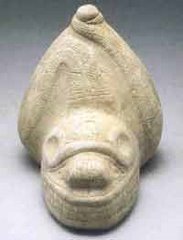
Did You Know - Chicho spring in Bayahibe, Dominican Republic is one of four individual caverns that makes up the "Padre Nuestro" complex, which is a series of water-containing sinkholes in limestone of the Pleistocene origin. The entrance of Chicho spring is a steep slop that descends 25m to a freshwater pool in an underground chamber. The chamber is 30m wide and 20m high and has some sunlight in the mouth of the cave during the day. The underwater pool itself is 8m wide by 20m long and has depths of 8m. The spring has no measurable flow and little runoff resulting in little sedimentation. It has crystal clear water that stays a constant 25 C year round. Currently the complex is used by a local resort for its water source, but this site was also used long ago by the local Taino people for gathering fresh water. Archaeologist used scuba equipment to help them with excavations in Chicho spring. They collected artifacts on several reconnaissance dives, producing an assemblage of 30 ceramic pieces. All of the ceramics are bottle forms and the assemblage included one intact vessel. Taino water bottles in the southeastern region of Dominican Republic are typically heart-shaped with zoomorphic or anthropomorphic heads attached on both sides. This bottle form is locally known as potiza and 28 of the ceramics followed this form. The artifact seen above is relatively simple, but the more elaborate potizas in museum collections show that the two lobes actually represent female breasts and is termed mammiform. The two non-potiza ceramics recovered were pieces of bottles with different forms, one with a double-bulbous form and one with a modeled, figurine-like body. - - UCTP Taino News © 2007

*See more photos of the ceramics excavated at Chico Spring at:http://lisahopwood.com/ceramicphotos.html

Tuesday, April 10, 2007

Batu is a Taíno Ball Game


Did You Know: Batu is an ancient Taíno ceremonial ball game, which has been regaining popularity in the Dominican Republic and Puerto Rico over recent decades. Similar to ball games played by Indigenous Peoples in Mesoamerica, opposing teams use a rubber ball in ways reminiscent of volleyball but without a net or the use of their "hands." 15th-century European colonizers marveled at the agility of Taíno ball players, men and women, and the game's main piece of equipment - the rubber ball. Europeans had never before seen this Taíno innovation. The Taíno used the sap/latex from certain trees, together with plant fibers, to construct the ball. Batu was used for conflict resolution, as well as for the fulfillment of certain spiritual and secular community needs. Besides oral tradition, the importance of Batu in ancient Taíno society is affirmed by the number of ball courts or batei "uncovered" by archeologists throughout the islands. The batei (batey) or ceremonial grounds were used not only for the game of Batu but for community ceremonies called "areito". The revival of Batu ball games have been documented in Puerto Rico (Jayuya) and the Dominican Republic (Azua) since the 1970s. The community members in the Dominican Republic currently maintain three Batu leagues each with their own leaders.- UCTP Taino News (c) 2007 

Wednesday, February 28, 2007

Quiskeya is a Taino Name


Did You Know: Quisqueya or Kiskeia (Kiskeya) is one of the Taino names for the island of Hispaniola, or what is now the Dominican Republic and Haiti. The name, is said to mean "Mother of the Earth," and is still used to this day. Many Dominicans still refer to their island as La Isla Quisqueya, and refer to themselves as Quisqueyano. – UCTP Taino News (c) 2007

Click on Map for Larger View