Saturday, December 21, 2019

Ancient DNA and Taíno Continuity


The genetic legacy of the Taíno. This analysis compares the Indigenous component identified in present-day Puerto Rican genomes with the approximately 1,000-year-old genome of a Lucayan Taíno woman from Preacher’s Cave, Eleuthera, Bahamas. The results demonstrate an element of biological continuity between precolonial Taíno ancestors and present-day Caribbean people. Source: Schroeder et al. (2018), Proceedings of the National Academy of Sciences, Figure 3. Licensed under CC BY-NC-ND 4.0.


Did You Know:
Scientists recovered a complete genome from a Lucayan Taíno woman who lived approximately 1,000 years ago? Her remains were excavated at Preacher’s Cave on Eleuthera in the Bahamas. Researchers obtained the ancient DNA from a tooth directly dated to approximately 776–992 CE. Strontium-isotope analysis indicated that she had grown up locally in the Bahamas.

The genome showed that this Lucayan Taíno ancestor was most closely related to present-day Arawakan-speaking Peoples from the Amazon and Orinoco regions of northern South America. This finding supports archaeological and linguistic evidence connecting the ancestors of Taíno Peoples with Indigenous communities of South America.

Researchers also compared her genome with those of present-day Caribbean people. They found that Indigenous components within some contemporary Caribbean genomes are closely related to the ancient Lucayan Taíno genome. The study therefore documented biological continuity between precolonial Taíno ancestors and people living in the Caribbean today—contradicting the long-promoted claim that Taíno Peoples simply became extinct.

Genetic ancestry, however, is only one form of evidence. Taíno identity and belonging cannot be determined by a commercial DNA test or genetic percentage alone. Kinship, community relationships, culture, history, language, and collective self-identification remain essential elements of Indigenous peoplehood.

— © 2019 UCTP Taíno News

References

Schroeder, H., Sikora, M., Gopalakrishnan, S., et al. (2018). Origins and genetic legacies of the Caribbean Taíno. Proceedings of the National Academy of Sciences, 115(10), 2341–2346. https://doi.org/10.1073/pnas.1716839115

Fernandes, D. M., Sirak, K. A., Ringbauer, H., et al. (2021). A genetic history of the pre-contact Caribbean. Nature, 590, 103–110. https://doi.org/10.1038/s41586-020-03053-2

Monday, November 18, 2019

Dogs in the Indigenous Caribbean

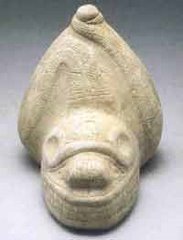
Ritual burial of a dog (aon), Punta Candelero, Humacao, Puerto Rico, approximately 250 BCE–400 CE, Huecoid tradition. Collection of the Museo y Centro de Estudios Humanísticos Dra. Josefina Camacho de la Nuez, Universidad Ana G. Méndez. Image reproduced for nonprofit educational commentary under fair use. View the original museum record.

Did You Know: Dogs lived alongside Indigenous Peoples in the Caribbean long before European colonization? Archaeologists have recovered the remains of domestic dogs (Canis familiaris) from precolonial sites throughout the region. These remains have been found in refuse deposits, placed in formal burials, and fashioned into modified objects. These different contexts suggest that dogs held varied and sometimes culturally significant roles within Indigenous Caribbean communities including for the Taíno.

Researchers examined dog remains from sixteen precolonial archaeological sites using measurements and isotope analysis. Strontium and oxygen isotopes preserved in tooth enamel helped investigators distinguish locally raised dogs from dogs that had come from elsewhere. The presence of nonlocal dogs indicates that some were transported between communities—most likely aboard kanoa as people traveled and exchanged goods throughout the islands.

The study also found that these dogs consumed a considerable amount of plant-based food. This pattern is consistent with people intentionally feeding them portions of the foods prepared within their communities. The archaeological evidence therefore presents dogs not simply as wild animals living near settlements, but as companions whose lives were closely connected with Indigenous Caribbean households, travel, and cultural practices. Two Taíno terms for dogs include aon and anli.

— © 2019 UCTP Taíno News

References

Shev, G. T., Laffoon, J. E., Grouard, S., & Hofman, C. L. (2020). An isotopic and morphometric examination of island dogs (Canis familiaris): Comparing dietary and mobility patterns in the precolumbian Caribbean. Latin American Antiquity, 31(3), 632–638. https://doi.org/10.1017/laq.2020.58

Saturday, October 12, 2019

Columbus and the Enslavement of Taíno People


Did You Know: On October 12, 1492 Christopher Columbus decided to take six Taíno people with him upon his return back to Spain. This act was the root of the trans-Atlantic slave trade. In a 1493 letter written to Ferdinand and Isabella, Columbus offered his patrons "slaves as many as they shall order be shipped" in exchange for the ships and resources needed for a second voyage. When he returned to the Caribbean, in February 1495, Columbus took by force 1600 Taíno to be enslaved. 560 slaves were shipped to Spain; 200 died en route, probably of disease and or abuse. After legal proceedings, the survivors were released and ordered to be shipped home. Others of the 1600 who were enslaved by Columbus and his men were distributed among the Spanish-colonial settlers. - © 2019 UCTP Taíno News 

References 

The Diario of Christopher Columbus's first voyage to America, 1492-1493. (1989). University of Oklahoma Press. 

James C. Clark of The Sentinel Staff. (2018, October 6). How Columbus created slave trade that changed world's economy. OrlandoSentinel.com. https://www.orlandosentinel.com/news/os-xpm-1992-05-17-9205160196-story.html

Saturday, August 17, 2019

Areito is Taíno

Members of the Kasibahagua Taíno Cultural Society shared a contemporary areito
 at the 2019 Bear Mountain Pow Wow in New York. 

Did You Know: The term areito (also spelled areyto) is a Taíno word that describes a socio-ceremonial blend of dance, music, song, and poetry. The areito played a significant role in the social, political, and religious life of the Taíno People. In the 15th and early 16th century, Spanish chroniclers in the Caribbean noted that the arieto were presented in the main plaza of the iukaieke (also spelled yucayeque) or village. Sometimes areito were conducted in a designated area in front of the home of a kasike or chieftain. These plazas or ceremonial grounds called batei had their borders defined by standing stones, often decorated or carved with various images, or by earthen embankments.

Dances during an areito could vary a great deal. Sometimes there were step-patterns moving along specific pathways. Walking patterns that went no more than a step or two in either direction were also used. According to a few of the descriptions given by Spanish chroniclers, some dances were comparable to what would be called line dances today. All the dances were lead by a tekina (a guide, teacher or dance master) of either sex who would use a call and response pattern of song and steps. Areito leaders determined the steps, words, rhythm, energy, tone, and pitch of a dance sequence. The dances could be based on ancient clearly choreographed steps or new choreography could be presented in this evolving art form. 
- © 2019 UCTP Taíno News 

References

Maestri, N. Areitos: Ancient Caribbean Taíno Dancing and Singing Ceremonies, ThoughtCo., https://www.thoughtco.com/areitos-ceremony-169589 

Atkinson L-G. 2006. The Earliest Inhabitants: The Dynamics of the Jamaican Taino. Kingston, Jamaica: University of West Indies Press. 

León T. 2016. Polyrhythmia in the Music of Cuba. Polyrhythmia in the Music of Cuba. Diagonal: An Ibero-American Music Review 1(2). 

Saunders NJ. 2005. The Peoples of the Caribbean. An Encyclopedia of Archaeology and Traditional Culture. Santa Barbara, California: ABC-CLIO. Scolieri PA. 2013. On the Areito: Discovering Dance in the New World. Dancing the New World: Aztecs, Spaniards, and the Choreography of Conquest. University of Texas Press: Austin. p 24-43. 

Simmons ML. 1960. Pre-Conquest Narrative Songs in Spanish America. The Journal of American Folklore 73(288):103-111. 

Thompson D. 1983. Music Research in Puerto Rico. College Music Symposium 23(1):81-96. 

Thompson D. 1993. The "Cronistas de Indias" Revisited: Historical Reports, Archeological Evidence, and Literary and Artistic Traces of Indigenous Music and Dance in the Greater Antilles at the Time of the "Conquista". Latin American Music Review / Revista de Música Latinoamericana 14(2):181-201.  

Wilson SC. 2007. The Archaeology of the Caribbean. New York: Cambridge University Press.

Friday, July 12, 2019

Caribbean Jade


Did You Know:
Jade is a generic term often used to describe various greenish gemstones found around the Greater Caribbean region, from the islands to the Caribbean-coastal areas of the continent. Archeologists, gemologists and others note there is a distinction between what is termed “true jade” and other stones, sometimes termed “social jade.” True jade includes nephrite and jadeite, which is harder and denser. Jadeite has a range of colors, but nephrite is found in cream and green colors. A related 
term jadeitite refers to rocks that consist mostly of jadeite, which is used as a carving material.  Social jade varies among serpentine, quartz, agates, turquoise, and radiolarian limestone. In the Antilles, these stones were used by the Indigenous Peoples of the region to produce and or distribute adornments and tools (utilitarian and ceremonial) that had temporal and spiritual significance. While jadeite items are relatively commonly known, serpentine items seem to be the most widely distributed. The lack of documented jadeitite quarries on the islands indicates that it was a valued trade item in ancient times
from island to island and or from the continent to the islands. - © 2019 UCTP Taíno News 


References

What is the Caribbean? An Archaeological Perspective, Reniel Rodriguez Ramos, Universidad de Puerto Rico, Utuado Campus, Caribbean Journal of Archaeology, 2010 


What is Jade?, Hobart King, Ph.D., Geology.com

Wednesday, June 12, 2019

Luku-Kairi Is Not a Recorded Taíno Term


American ethnologist and philologist, Daniel G. Brinton

Did You Know: The expression luku-kairi, sometimes written luku-cairi, is a nineteenth-century linguistic reconstruction rather than a self-designation documented from the Indigenous Peoples of the Bahamas during the early colonial period. Unlike Taíno, a term documented in early colonial sources as having been spoken by Caribbean Indigenous Peoples, luku-kairi does not appear in any known fifteenth- or sixteenth-century account as an Indigenous Caribbean expression or self-designation.

The earliest identified published explanation of this construction appears in The Arawak Language of Guiana in Its Linguistic and Ethnological Relations (1871), written by the American ethnologist and philologist Daniel Garrison Brinton. Seeking to explain the Spanish name Lucayos, Brinton compared it with vocabulary from the Arawak language of Guiana. He proposed that Lucayos developed from lukku, meaning “man,” and kairi, meaning “island.” Brinton combined these words as lukku kairi—“men of the islands”—which he stated was shortened to lukkairi and later rendered by Europeans as Lucayos.

Brinton did not, however, cite an early colonial document in which an Indigenous Caribbean speaker used lukku kairi as the name of the Bahamian people. His explanation was based on a retrospective comparison with related mainland Arawakan vocabulary. It should therefore be understood as Brinton’s proposed etymology—not as a historically recorded Taíno phrase.

Bartolomé de las Casas offered a different account in Historia de las Indias. Referring to the people and islands commonly called Lucayos, he wrote “Lucayos, o por mejor decir Yucayos”—“Lucayos, or more properly Yucayos.” Other early spellings also included forms such as Yucayas. These records demonstrate that Yucayo and Yucayas belong to the early colonial documentary tradition, whereas luku-kairi first appears as a much later scholarly reconstruction.

The distinction is important: linguistic comparisons can help researchers explore possible relationships among languages, but a reconstructed expression should not be presented as a historically documented Taíno self-designation.

— © 2019 UCTP Taíno News


-----

References:

Brinton, D. G.
(1871). The Arawak language of Guiana in its linguistic and ethnological relations.
Transactions of the American Philosophical Society, 14(3), 427–444.

Las Casas, B. de. (1875). Historia de las Indias (Vol. 3). Imprenta de Miguel Ginesta. (Original work written ca. 1527–1561)
Ramos y Duarte, F. (1897). Estudio filológico del nombre “Lucayo” ó “Yucayo.” In Actas del XI Congreso Internacional de Americanistas (pp. 535–540). Agencia Tipográfica de F. Díaz de León