Showing posts with label Arawak. Show all posts

Saturday, October 12, 2019

Columbus and the Enslavement of Taíno People


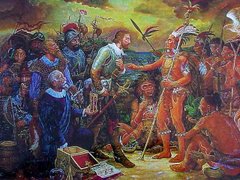
Did You Know: On October 12, 1492 Christopher Columbus decided to take six Taíno people with him upon his return back to Spain. This act was the root of the trans-Atlantic slave trade. In a 1493 letter written to Ferdinand and Isabella, Columbus offered his patrons "slaves as many as they shall order be shipped" in exchange for the ships and resources needed for a second voyage. When he returned to the Caribbean, in February 1495, Columbus took by force 1600 Taíno to be enslaved. 560 slaves were shipped to Spain; 200 died en route, probably of disease and or abuse. After legal proceedings, the survivors were released and ordered to be shipped home. Others of the 1600 who were enslaved by Columbus and his men were distributed among the Spanish-colonial settlers. - © UCTP Taíno News 

Sources: 

The Diario of Christopher Columbus's first voyage to America, 1492-1493. (1989). University of Oklahoma Press. 

James C. Clark of The Sentinel Staff. (2018, October 6). How Columbus created slave trade that changed world's economy. OrlandoSentinel.com. https://www.orlandosentinel.com/news/os-xpm-1992-05-17-9205160196-story.html

Saturday, June 07, 2014

Kakata is Taino

Caribbean tarantula or kakata found in Borikén (Puerto Rico). Photo by Alfredo Colon


Did You Know: Caribbean tarantulas are found throughout the Caribbean islands and are a part of the 'New World" tarantula group. The indigenous Taino word for tarantula is kakata (cacata). The bite of a kakata is not fatal to humans even though it does posses venom. Kakata have defensive, urticating hairs, which cause itching and discomfort when harassed. The male kakata can usually be seen in the open, as they often are in search of mates. Females are also visible, but tend to stay near their homes. Some kakata are burrowing while others construct nest made of webs in trees. In the Taíno language, word kakata means to "mix" as with the hands, which brings to mind the movement of this large and hairy arachnid. - UCTP Taino News © 2014

Sunday, February 09, 2014

Semí is Taíno


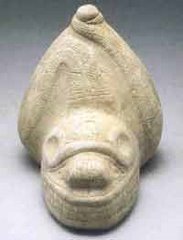
Did You Know: In Taíno culture, a semí (cemi, zemi) is a deity, an ancestral spirit, or a spiritual manifestation representing a specific aspect of or an element of nature. Pronounced seh-mee, the word can also refer to a sacred physical icon that represents a spirit or deity, which traditionally can be presented in wood, bone, shell, clay, cotton, beadwork, or stone. Some academics have promoted the word as 'zemi,' however; this is a corrupted version of the Taíno word based on the imposition of the Spanish language. In the related Lokono Arawak language the word “semee” is associated to the concept of sweetness while “semechichi” refers to a community healer. Similar versions of the word/concept semí also appear in other neighboring and related languages. In the eyeri/igneri/ieri language, for instance, the equivalent word is 'chemín' while in the insular carib or Kalinago language we find 'chemíjn,' sometimes written as 'semígn.' – UCTP Taino News © 2014

Friday, May 04, 2012

ANAMU


Did You Know - Anamu is the Taino name for a tropical plant (Petiveria allliacea) found throughout Latin America, the Caribbean, and Florida. The leaves of the Anamu plant can be used fresh or dried and made into an herbal tea, or they can be chewed.  Anamu produces a strongly pungent leaf and root; it is known for its distinct garlic-like smell. Throughout the Caribbean and beyond Anamu is used as a natural remedy for many physical ills and certain medical conditions including arthritis, skin conditions, intestinal gas, sinus problems, pain, and even cancer. Local oral traditions claim that Anamu has the ability to ward off bats, insects, and mischievous Spirits.  – UCTP Taino News © 2012

*Disclaimer: Any reference to medicinal use is not intended to treat, cure, or prevent disease. Please check with your doctor or health care professional before using.

Monday, September 06, 2010

Jamaican Jerk

Did You Know: The culinary style known as "Jamaican jerk" refers to a method of slow cooking meat, traditionally seasoned with or cooked over the wood of the pimento (allspice). The use of ahi (aji), the Taino word for pepper, pronounced "ah-hee," is another signature ingredient with "Scotch bonnet peppers" among the most widely used.  Additional spices were also incorporated and dry-rubbed or marinated into the meat. Locally, this tradition is said to go back more than 1,200 years to when indigenous Taino Peoples, the island's original inhabitants, used these methods before cooking the marinated meats over a type of  wooden grate called barbakoa. From this Taino term, the English word barbecue originates. The term jerk is said to originate from the word charqui, an indigenous word of Quechua origin for dried meat, which was incorporated into Spanish, eventually becoming jerky in English. -- UCTP Taino News © 2010 

Thursday, December 17, 2009

The Caribbean


Did You Know: The word “Caribbean” is said to be derived from the name of one of the dominant indigenous (Amerindian) groups in the region at the time of European contact during the late 15th century, the Caribs. While their continues to be debate among scholars as to the origin of the word, at least one of the communities currently identified as "Carib" call themselves Kalinago. The island of Boriken (Puerto Rico) itself was also identified as Carib in some old maps. Some of the other Indigenous Nations identified in the region are Arawak, Ciboney, Galibi, Garifuna, Igneri, Lucayan, and the Taino. - - UCTP Taino News © 2009

Wednesday, May 06, 2009

Flat Foreheads

Did You Know: A flat forehead was considered very attractive in many Taino communities. Mothers carried their newborn babies on their backs with a padded, wooden board. The board would lay across the child's head and flattened the impressionable forehead.- - UCTP Taino News © 2009

Sunday, March 30, 2008

Jamaica and the Taino


Did You Know - The Jamaican national motto is ‘Out of Many One People’, based on the population’s multi-racial roots. This motto is represented on the Coat of Arms, showing a male and female member of the Taino Tribe standing on either side of a shield which bears a red cross with five golden pineapples. The crest shows a Jamaican crocodile mounted on the Royal Helmet of the British Monarchy and mantling. - UCTP Taino News © 2008