Did You Know: One of the earliest Spanish accounts from Kiskeia records an incident in which Taíno men took Christian religious images from a chapel and buried them in a cultivated field, declaring that the crops would now grow well and abundantly. Friar Ramón Pané, writing in the late fifteenth century, interpreted their actions through a Christian colonial worldview, describing them as an intentional desecration and mockery of the images. Yet Pané's own account preserves an important detail: the Taíno explicitly connected the burial of the images with the fertility and productivity of the cultivated field.
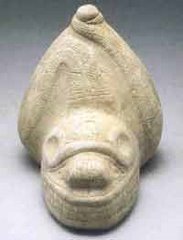
Seen from a Taíno cultural perspective, the incident tells a very different story. Taíno spiritual and agricultural practices were deeply interconnected, and semí (cemí) could embody spiritual powers associated with fertility, food production, and the forces sustaining life. Contemporary Taíno leaders rebuke claims of desecration. Several modern scholars have also questioned the colonial interpretation of the incident as simple "desecration." The Christian images would have been understood within an existing Taíno spiritual framework and treated as powerful sacred objects. Their potency could be placed into relationship with the cultivated earth. In other words, actions the Spanish interpreted as contempt would have represented an Indigenous attempt to understand—or even test and incorporate—the spiritual power claimed for these unfamiliar sacred images.
The consequences demonstrate how deadly such cultural misunderstandings could become under colonial rule. Pané reports that after the incident was brought to Bartolomé Colón, acting as governor in his brother Christopher's absence, proceedings were brought against those responsible and the Taíno men were publicly burned alive. Their deaths remind us why early colonial chronicles must be read critically: European writers recorded invaluable information about Taíno life, but they also interpreted what they witnessed through their own religious beliefs, political interests, and cultural assumptions. Recovering Taíno history therefore requires us not only to read what the chroniclers wrote, but also to examine the Indigenous meanings that may still be visible beneath their interpretations.
References:
Ramón Pané. An Account of the Antiquities of the Indians. Written ca. 1498. New edition with introductory study, notes, and appendices by José Juan Arrom; translated by Susan C. Griswold. Duke University Press, 1999.
José Juan Arrom, ed. Relación acerca de las antigüedades de los indios: el primer tratado escrito en América. Based on the account of Fray Ramón Pané. [For the English scholarly edition: Duke University Press, 1999.]
Anthony M. Stevens-Arroyo. Cave of the Jagua: The Mythological World of the Taínos. University of New Mexico Press, 1988. The National Park Service's historical documentation specifically cites Stevens-Arroyo's analysis of this episode, noting that the Taíno treated the Catholic images as cemíes and that the Spanish interpreted this as desecration.