Did You Know: The cashew tree (Anacardium occidentale) is said to have originated in northeast Brazil, however, it
is widely distributed through tropical South and Central America and the
Caribbean. In Borikén (Puerto Rico) and Kiskeia (Dominican Republic), what are
understood to be Taino words for cashew are still used today, incorporated in
the local Spanish language including kahuil (prounounced kah-hoo-eel), pahuil (pajuil), and pauhil. An
additional, more rarely used term for cashew in Borikén is pahui (pajuy/pah-hoo-ee). All
these terms seem to be related linguistically to the term for cashew used in indigenous
Tupian languages - acajú
- said to mean
“nut that produces itself.” The cashew tree is large and evergreen, growing to
10-12m (32 ft) tall. It produces a type of fruit (known in English as ‘cashew
apple’ or ‘marañón’
in Spanish), which is edible, and has a strong "sweet" smell
and a sweet taste. The cashew nut is really a seed and a good source of
antioxidants, but it needs to be roasted or steamed as it contains urushiol, a resin that can cause skin rashes, and can be toxic when ingested. Urushiol is also present in the tree's leaves. Traditional medicinal uses of the cashew tree include grinding the
seeds into a poultice for treating snakebites, and the use of the fruit, bark, and leaves for
many other purposes including anti-fungal activity, for sores and rashes, or as
an antipyretic, and for antidiarrheal applications. – UCTP Taino News © 2014
Showing posts with label Kiskeia. Show all posts
Monday, March 17, 2014
Cashews and Taino People
Monday, September 02, 2013
Guayiga and Marunguey are Taino
Did You Know: Traditionally, Taino People made special use of a type of cycad plant species in
the Zamia family that grows in several
varieties throughout the Caribbean, the Bahamas, and even Florida (Zamia pumila,
Zamia debilis, Zamia amblyphyllidia, Zamia
integriflora, etc). This
plant is known as guayiga in Kiskeia
(Dominican Republic), it also is known as marunguey in Borikén (Puerto Rico). The indigenous Seminole
Peoples of Florida call it Coonti. In
Kuba (Cuba) these plants are known as
Yuquilla de ratón or Yuquilla de paredón. While guayiga/marunguey
is extremely poisonous, the Taino learned to make a bread called Chola or Cholla, out of its roots. The production of this bread is similar
to that of Taino kasabe
(yuka/cassava/manioc bread). According to local traditional knowledge, once the
bread is made, it is left outside, and when insects begin to land on it, the
bread is deemed ready to be consumed as the poisons have been sufficiently
extracted. Today, on the island of Kiskeia,
the communities of Higuey and Haina produce most of the chola bread
made on the island. – UCTP Taino News ©
2013
Labels:
Bahamas,
Boriken,
Chola,
Cholla,
Coonti,
guayiga,
kasabe,
Kiskeia,
marunguey,
Taino,
Zamia amblyphyllidia,
Zamia debilis,
Zamia integriflora,
Zamia pumila
Sunday, June 30, 2013
Batea is Taino
Did You Know: Batea are oval or circular
wooden trays used traditionally by Taino to carry food, wash clothes, or pan
for gold. Today, Taino and others in Kiskeia (Dominican Republic) continue to make
and use them for these same purposes, still calling them batea, which is
its Taino name. Batea is pronounced "bah-teh-ah." - UCTP Taino News (c) 2013
Sunday, February 17, 2013
Taíno Political Organization
Did You Know: Taíno society was organized in two sectors - nitaíno (community
leaders) and naboria (general community
members). Community life was administrated
by chiefs and sub-chiefs called kasike
(cacique), who in turn were supported and often advised by other community and spiritual
leaders called behike and buhiti among other names. The traditional
territories (called cacicazgos
by the Spaniards) controlled by kasike were actually confederations of iukaieke (yucayeque) communities with
populations that ranged from several hundred to thousands of people. As Taíno
society developed over time, powerful kasike (caciques) united these communities
into political states that were ultimately guided by a grand or paramount chief.
In 1492, Kiskeia (Hispaniola) was organized under five confederations. Boriken
(Puerto Rico) was organized under 20, with the Guainia (Guaynia) territory
being the largest and most politically powerful. - UCTP Taíno News © 2013
Saturday, February 25, 2012
Kasabi: Bread made from iuka (yuca)

DID YOU KNOW - Traditionally, bread made from iuka or cassava is known in the Taíno language as kasabi (kasabe). It was created by grating iuka (yuca, cassava/manioc) flour into flat disks and roasting them on flat ceramic griddles called burén over a cooking fire. Today, the baking of kasabi, now more commonly called kasabe, is modernized for increased production, but it is still presented in the original flat, round style. Whether made from bitter or sweet varieties of iuka/manioc, kasabi is known to preserve exceedingly well with a preservative-free shelf life of about 8 months. In the time of the ancient Taino, it was taken on long journeys over land and sea without spoiling, providing a sometimes a much-needed burst of carbohydrates. The bitter cassava is said to produce a kind of kasabi that was virtually “unassailable by vermin” since it retained a small amount of hydrocyanic toxin harmless to humans but harmful or deadly to insects and rodents. Hab jao (jab jao) is the Taíno name still given to the thinnest kasabi in Kiskeia (Dominican Republic). According to Taino tradition hab hao or hau hau (xau xau) was reserved for community leaders and dignitaries. Since the 1970s, kasabe production in Kiskeia has expanded the availability of this ancient Taino culinary tradition from the local to international markets. - UCTP Taino News © 2012
Tuesday, December 20, 2011
Guaikano
DID
YOU KNOW: The
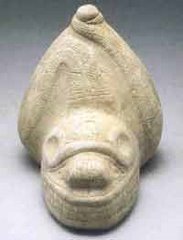
term guaikano (guaicano) or guaikan is a Taíno word for the remora
fish (scientific name: Echeneidae).
Sometimes called a suckerfish,
the guaikano (remora) is best
known for its distinctive dorsal fin, which takes the form of an oval,
sucker-like organ allowing them to take a firm hold against the skin of larger
marine animals and even boats. Usually found in tropical or temperate waters, guaikano are known to grow between 1-3 ft
long (30–90 cm). Among the Taíno,
the guaikano was once used by fisherman,
specifically, because of its abilities to attach on to larger animals such as
turtles and sharks. A cord or “kabuia (cabuya)”
would be tied to the guaikano’s tail, and once the fish attached, a Taíno
fisherman could simply haul in both the guaikano
and its host. - UCTP Taino News ©
2011
Illustration: Modesto Garcia
Subscribe to:
Posts (Atom)