Did You Know: The cashew tree (Anacardium occidentale) is said to have originated in northeast Brazil, however, it
is widely distributed through tropical South and Central America and the
Caribbean. In Borikén (Puerto Rico) and Kiskeia (Dominican Republic), what are
understood to be Taino words for cashew are still used today, incorporated in
the local Spanish language including kahuil (prounounced kah-hoo-eel), pahuil (pajuil), and pauhil. An
additional, more rarely used term for cashew in Borikén is pahui (pajuy/pah-hoo-ee). All
these terms seem to be related linguistically to the term for cashew used in indigenous
Tupian languages - acajú
- said to mean
“nut that produces itself.” The cashew tree is large and evergreen, growing to
10-12m (32 ft) tall. It produces a type of fruit (known in English as ‘cashew
apple’ or ‘marañón’
in Spanish), which is edible, and has a strong "sweet" smell
and a sweet taste. The cashew nut is really a seed and a good source of
antioxidants, but it needs to be roasted or steamed as it contains urushiol, a resin that can cause skin rashes, and can be toxic when ingested. Urushiol is also present in the tree's leaves. Traditional medicinal uses of the cashew tree include grinding the
seeds into a poultice for treating snakebites, and the use of the fruit, bark, and leaves for
many other purposes including anti-fungal activity, for sores and rashes, or as
an antipyretic, and for antidiarrheal applications. – UCTP Taino News © 2014
Showing posts with label Kuba. Show all posts
Monday, March 17, 2014
Cashews and Taino People
Thursday, December 19, 2013
Hikotea is Taino
Did
You Know: “Hikotea” (jicotea) is a Taino word for various land and fresh water
turtles. The term hikotea (hee-koh-teh-ah) is still used throughout the Greater Antilles to
identify these turtles. In ancient times the hikotea was directly linked to Taino
creation, as the primordial mother of the people was a turtle who transformed
into a woman. As a result of this ancestral distinction, many persons still
view it as an offense to kill or eat a fresh water or land turtle. A further
spiritual distinction of the hikotea is that it carries the numbers of a sacred calendar
of the people on its shell. Patterns on the outer edge of its shell coincide
with the sacred lunar calendar cycle of 28 days from full moon to full moon.
The hikotea’s additional shell patterns correspond with the 13 moons of the
lunar year. - UCTP Taino News (c) 2013
Tuesday, December 20, 2011
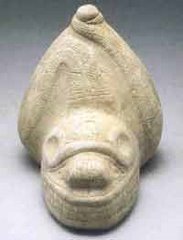
Guaikano
DID
YOU KNOW: The
term guaikano (guaicano) or guaikan is a Taíno word for the remora
fish (scientific name: Echeneidae).
Sometimes called a suckerfish,
the guaikano (remora) is best
known for its distinctive dorsal fin, which takes the form of an oval,
sucker-like organ allowing them to take a firm hold against the skin of larger
marine animals and even boats. Usually found in tropical or temperate waters, guaikano are known to grow between 1-3 ft
long (30–90 cm). Among the Taíno,
the guaikano was once used by fisherman,
specifically, because of its abilities to attach on to larger animals such as
turtles and sharks. A cord or “kabuia (cabuya)”
would be tied to the guaikano’s tail, and once the fish attached, a Taíno
fisherman could simply haul in both the guaikano
and its host. - UCTP Taino News ©
2011
Illustration: Modesto Garcia
Subscribe to:
Posts (Atom)