Did You Know: In Taíno culture, a semí (cemi, zemi) is a deity, an ancestral
spirit, or a spiritual manifestation representing a specific aspect of or an
element of nature. Pronounced seh-mee,
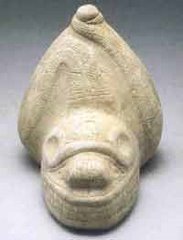
the word can also refer to a sacred physical icon that represents a spirit or deity,
which traditionally can be presented in wood, bone, shell, clay, cotton,
beadwork, or stone. Some academics have promoted the word as 'zemi,' however;
this is a corrupted version of the Taíno word based on the imposition of the
Spanish language. In the related Lokono Arawak language the word “semee” is
associated to the concept of sweetness while “semechichi” refers to a community healer.
Similar versions of the word/concept semí also appear in other neighboring and related languages.
In the eyeri/igneri/ieri
language, for instance, the equivalent word is 'chemín' while in the insular carib or Kalinago language we find 'chemíjn,' sometimes
written as 'semígn.' – UCTP Taino News © 2014