Saturday, July 12, 2008

Taino Guayuko


DID YOU KNOW - The Spanish chronicler Gonzalo Fernandez de Oviedo y Valdez (1478-1507) recorded the word guayuko or guaiuko to refer to a type of breech cloth that was small and covered the genital area. A breechcloth (sometimes called Lioncloth) is a long rectangular piece of cloth. It is worn between the legs and tucked over a belt or cord, so that the flaps fell down in front and behind. In Boriken (Puerto Rico) the word was widely used in the rural areas and coastal cane fields and came to refer to an old pair of worn Khakis working pants up until around the 1950s. Although the term has largely fallen out of use some elders and language enthusiasts have kept the word alive. A similar term is nagua. Although the original Taíno term nagua referred to a breech cloth over the years it has come to refer to pantyhose and is sometimes also called enagua.- - UCTP Taino News © 2008

Sunday, June 15, 2008

Guaisa


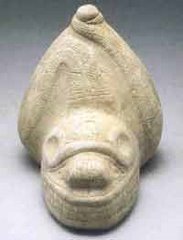
DID YOU KNOW - In his diary written from a vessel moored off the coast of Hispanola, Columbus described the Taino Kasike (chieftains) wearing intricately carved, small sized mask or amulets around their necks. The Taino call these little mask pendants "Guaisa" and often they were inlaid with gold. Some contempoary Taino translate "guaisa" to mean "our face or "our seed". Guaisa could be fashioned out of clay, wood, bone, shell or even stone. - UCTP Taino News © 2008
Monday, May 05, 2008

Parrots and Taino

Did You Know - The ancient Taino people developed an ingenious and sophisticated way of trapping certain birds especially parrots. To capture the birds, children would wear a specially woven hat made from palm tree material, and then hide in selected trees. Once in the tree, the children would also coat various branches with a special sticky resin. Finally, for this trap to be successful the child hunter would take along live parrot whose squawks would attract other birds to the tree. Once landing in the trees, the parrots would become stuck to the resin and easily captured by the young Taino hunters. Parrots were favored among community members because of their beauty and the ability to be domesticated. Some Taino terms for parrots include Kaika, Paraka, and Higuaka. – UCTP Taino News © 2008

Wednesday, April 02, 2008

Hutia are a part of the Taino World


Did You Know: The Hutia is a large indigenous rodent that inhabits various Caribbean Islands. The average size ranges from about 20 to 60 centimeters (8-24 inches), and they can weigh up to 7 kilograms (15 pounds). At least 20 species of hutia have been identified, but as many as half may be extinct. Among those that are said to have perished are the giant hutia, which are said to have resembled the modern capibara. Tails are present among the species, varying from vestiges to prehensile. Hutia have stout bodies and large heads. Most species are herbivorous, though some consume small animals. Like other rodents most hutia are nocturnal, but instead of burrowing underground, they can nest in trees or even rock crevices. The word Hutia is a word from the Taino language and during ancient times these rodents were hunted regularly for their meat. The consuming of hutia continues among some traditionalists; however, this animal is endangered in many countries. Hutia once lived throughout most all regions of the islands from the coast to the forest to the sabanas. - UCTP Taino News © 2008

Sunday, March 30, 2008

Jamaica and the Taino


Did You Know - The Jamaican national motto is ‘Out of Many One People’, based on the population’s multi-racial roots. This motto is represented on the Coat of Arms, showing a male and female member of the Taino Tribe standing on either side of a shield which bears a red cross with five golden pineapples. The crest shows a Jamaican crocodile mounted on the Royal Helmet of the British Monarchy and mantling. - UCTP Taino News © 2008

Monday, February 11, 2008

Lunar Eclipse Saved Columbus


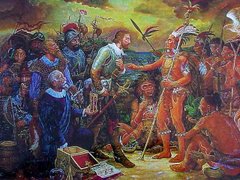
Did You Know - According to Spanish accounts, during Christopher Columbus' fourth and final voyage in 1504, the admiral saved his starving and shipwrecked crew by using an elaborate plan designed to deceive Jamaican Taino into feeding them. Columbus predicted his Christian god would make the moon "inflamed with wrath" and "do evil things to them" if his men were not fed. A lunar eclipse appeared, making his prediction come to pass. Columbus was able to accomplish this rouse thanks to Johannes Regiomontanus, a German scientist who published an almanac that charted solar and lunar eclipses during 1475-1506. Studying the almanac, Columbus learned that a total eclipse of the moon would happen on Feb. 29, 1504. Columbus and his crew were shipwrecked in Jamaica on June 25th 1503. Local Taino initially welcomed him and provided the castaways with food and shelter. However, after being stranded for more than six months, at least half of Columbus’ men mutinied - robbing and murdering several Taino. After this horrific turn of events, the Taino refused to assist Columbus any longer and planned to do away with the crewmen. Seeing his situation as desperate and armed with the knowledge contained in the almanac, he called a meeting with a local Taino kasike (chief) to share an "ominous prediction" before the scheduled eclipse. He announced to the kasike that the Christian god was “angry” because the Taino “were no longer supplying his men with food.” Columbus then stated in “three nights” he would all but obliterate the rising full moon, making it appear "inflamed with wrath;" a signal that “evils” would soon be inflicted upon all the islanders. When the moon turned an "eerie red" as he had "predicted," the reportedly “terrified” Taino brought food to Columbus' men, and allegedly pleaded with him to return it to normal. Columbus announced he would privately confer with his god, and when he returned he said the moon would revert back to its natural state, and it did. The Taino continued to provide supplies for Columbus and his men until they left Jamaica when a relief ship from Hispaniola finally arrived on June 29, 1504. – UCTP Taino News © 2008