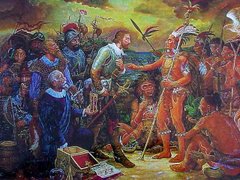
DID YOU KNOW: Hatuei (Hatuey) was a Taíno kasike (chief) from the island of Kiskeia (Hispaniola), who lived in the early sixteenth century. Hatuei fled Kiskeia with about 400 followers to warn the Taino of Kuba about the Spaniards. Bartolomé de Las Casas later attributed the following speech to Hatuei while he was showing a basket of gold to the Sibonei Taíno community of Kaobana. Hatuei declared “Here is the God the Spaniards worship. For these they fight and kill; for these they persecute us and that is why we have to throw them into the sea... They tell us, these tyrants, that they adore a God of peace and equality, and yet they usurp our land and make us their slaves. They speak to us of an immortal soul and of their eternal rewards and punishments, and yet they rob our belongings, seduce our women, violate our daughters. Incapable of matching us in valor, these cowards cover themselves with iron that our weapons cannot break...” As a result of Hatuei’s guerrilla tactics against the Spaniards, he was able to confine them to their fort at Baracoa for a time. He was finally captured and before he was burnt alive at the stake, a priest asked him if he would accept Jesus and go to heaven. Hatuei asked the priest “if Christians went to heaven.” The priest answered “yes” to which Hatuei is said to have replied “I do not want to go there so let me burn as I will not be anywhere where they are and where I would see such cruel people”. Hatuei was executed by the Spaniards on February 2, 1512. He is celebrated as "Cuba's First National Hero." – UCTP Taino News © 2011
Wednesday, February 02, 2011
Hatuei...
DID YOU KNOW: Hatuei (Hatuey) was a Taíno kasike (chief) from the island of Kiskeia (Hispaniola), who lived in the early sixteenth century. Hatuei fled Kiskeia with about 400 followers to warn the Taino of Kuba about the Spaniards. Bartolomé de Las Casas later attributed the following speech to Hatuei while he was showing a basket of gold to the Sibonei Taíno community of Kaobana. Hatuei declared “Here is the God the Spaniards worship. For these they fight and kill; for these they persecute us and that is why we have to throw them into the sea... They tell us, these tyrants, that they adore a God of peace and equality, and yet they usurp our land and make us their slaves. They speak to us of an immortal soul and of their eternal rewards and punishments, and yet they rob our belongings, seduce our women, violate our daughters. Incapable of matching us in valor, these cowards cover themselves with iron that our weapons cannot break...” As a result of Hatuei’s guerrilla tactics against the Spaniards, he was able to confine them to their fort at Baracoa for a time. He was finally captured and before he was burnt alive at the stake, a priest asked him if he would accept Jesus and go to heaven. Hatuei asked the priest “if Christians went to heaven.” The priest answered “yes” to which Hatuei is said to have replied “I do not want to go there so let me burn as I will not be anywhere where they are and where I would see such cruel people”. Hatuei was executed by the Spaniards on February 2, 1512. He is celebrated as "Cuba's First National Hero." – UCTP Taino News © 2011

Monday, November 01, 2010
Guaikan, Columbus, and the Hebrew language
Did You Know: In 1492, the official interpreter for Christopher Columbus' fleet was Luis de Torres who was a converted Jew. Torres was chosen as fleet interpreter because he spoke Hebrew and Arabic. After many attempts, Torres was unable to converse with the Taino people in Hebrew so Columbus decided to kidnap several Taino to try and teach them Spanish. One of the young Taino kidnapped was named Guaikan. He was taught to speak Spanish and became the interpreter for the expedition. Guaikan became Cristobol Colón's (Christopher Columbus) adopted Taino son. He took the name Diego Colón and sailed with Columbus on his subsequent voyages. – UCTP Taino News © 2010
Tuesday, October 12, 2010
More than one Agueybana

Did You Know: The Taino ‘name’ Agueibana (Agueybana) is related to more than one indigenous historical figure. In the 15th century, among those persons recorded with the name Agueybana in Boriken (Puerto Rico) were 'Agueybana the elder', the leader who entered into guaitiao (making relations ceremony) with Ponce de Leon and 'Agueybana el Bravo' , the leader who led a latter attack against Spanish forces. Along with these two Kasike (leaders), there are at least two naboria (local people), Martinicio and Perico, who carried the 'name' Agueybana. They were documented within the encomienda system in Boriken. There is also a record of another leader named Francisco Agueybana residing in Kiskeia (Dominican Republic) during the same time period as those who were recorded in Boriken. - UCTP Taino News © 2010
Monday, September 06, 2010
Jamaican Jerk

Did You Know: The culinary style known as "Jamaican jerk" refers to a method of slow cooking meat, traditionally seasoned with or cooked over the wood of the pimento (allspice). The use of ahi (aji), the Taino word for pepper, pronounced "ah-hee," is another signature ingredient with "Scotch bonnet peppers" among the most widely used. Additional spices were also incorporated and dry-rubbed or marinated into the meat. Locally, this tradition is said to go back more than 1,200 years to when indigenous Taino Peoples, the island's original inhabitants, used these methods before cooking the marinated meats over a type of wooden grate called barbakoa. From this Taino term, the English word barbecue originates. The term jerk is said to originate from the word charqui, an indigenous word of Quechua origin for dried meat, which was incorporated into Spanish, eventually becoming jerky in English. -- UCTP Taino News © 2010
Monday, August 09, 2010
The Taino Duho and UNESCO...
 Did You Know: In 1997, UNESCO had an ongoing project, Insula 2000, and chose this opportunity to strike a medal in memory of the Taino, awarded to individuals who have distinguished themselves in the defense of peace and democracy in Latin America and the Caribbean. The obverse side features a duho, a low four-legged ceremonial chair sculpted from a guaiakan tree native to the many Caribbean islands. Dating back from the 12th to the 14th century, the masterpiece of Taino art displayed on the UNESCO medal is currently in the possession of the Musée de l’Homme in Paris. According to Taino understanding the carved effigy represents a particular Spirit or "Cemi" endowed with the faculty of "moving". During ceremonial rituals, entranced spiritual leaders or community leaders called Kasike sit on the duho and “travel” to dialogue with the Spirit World. On non-religious occasions, a distinguished guest can be invited to sit on this chair which, for UNESCO, symbolizes cultural exchanges and understanding between peoples. The reverse of the medal is plain. - - UCTP Taino News © 2010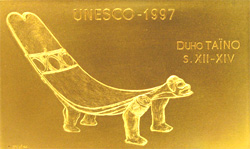
Tuesday, July 20, 2010
The Traditional Taino Diet
 Did You Know: The traditional diet of the Taino was based mainly on community cultivated agricultural products, supplemented with wild fruits as well as fishing, and limited hunting. Root tubers such as yuka (manioc) and batata (sweet potatoes) were cultivated along with many other diverse food crops like maisi (corn), mani (peanuts), calabasa (pumpkin), iaiama (pineapple), cahuil (cashews), beans, aji (peppers) etc. The hunting of small game such as birds, small mammals, and reptiles such as iguanas, and snakes was also practiced daily by community members. The ocean and rivers were also exploited in a sustainable manner for their bountiful resources. The Taino harvested edible marine-life, including conch, oysters, lobsters, clams, and crabs. Fish were caught with bone and shell hooks, large mesh nets, nasa (fish traps), spears, and bows and arrows. Some of the larger marine-life that the Taino encountered and hunted included the manati (sea cow), tuna, sea turtles, and sharks. Occasionally, even a pilot whale was taken for by various communities. Taino survival was secured by the application of ancient traditional knowledge, which included practical and medicinal knowledge of plants, an deep understanding and symbiotic relationship with their environment, and the ability to apply appropriate tools and techniques. - UCTP Taino News © 2010
Subscribe to:
Posts (Atom)