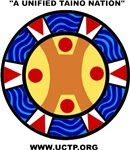
Did You Know: The flag of the United
Confederation of Taíno People (UCTP) represents Taíno people “reaching out in
solidarity” across the Caribbean Sea in all the sacred directions wherever
their relatives can be found. The original
flag symbol was created in 1997 for the UCTP by artist Marie Crooke and further
elaborated by artist Joe Leon. The UCTP flag is a part of the
permanent collections of and displayed at the Smithsonian’s National Museum of
the American Indian in Washington, D.C.; the Mashantucket Pequot Museum in
Connecticut; the Institute of American Indian Arts in New Mexico; the
Virgin Islands National Parks Service; and the Sami Parliament in Norway. – UCTP Taino
News (c) 2013
Friday, March 08, 2013
Sunday, February 17, 2013
Taíno Political Organization
Did You Know: Taíno society was organized in two sectors - nitaíno (community
leaders) and naboria (general community
members). Community life was administrated
by chiefs and sub-chiefs called kasike
(cacique), who in turn were supported and often advised by other community and spiritual
leaders called behike and buhiti among other names. The traditional
territories (called cacicazgos
by the Spaniards) controlled by kasike were actually confederations of iukaieke (yucayeque) communities with
populations that ranged from several hundred to thousands of people. As Taíno
society developed over time, powerful kasike (caciques) united these communities
into political states that were ultimately guided by a grand or paramount chief.
In 1492, Kiskeia (Hispaniola) was organized under five confederations. Boriken
(Puerto Rico) was organized under 20, with the Guainia (Guaynia) territory
being the largest and most politically powerful. - UCTP Taíno News © 2013
Tuesday, January 08, 2013
Taíno vegetable root tuber: iautía (yautía)
Did You Know: Among the various indigenous vegetable root tubers cultivated traditionally by Taíno people, iautía (yautía) was, and remains a favorite. Similar to the Taíno staple of iuka (yuca), the iautía tuber has an elongated shape and the skin is bumpy, patchy, brown, and shaggy and it needs to be cooked before it is eaten as it contains some toxins. It has a nutty, earthy flavor with starchy consistency when prepared and its flesh can be white, yellow, pink or purplish. In much of the Greater Antilles the tuber is still identified by its Taíno name – iautía - however; it is also sometimes called malanga, tannia, or cocoyam. In the Lesser Antilles iautía is also called dasheen and is often confused with the similar plant taro. The young, unfurled leaves of some varieties are sometimes boiled in soups or stews such as in Caribbean callaloo. The iautía’s botanical genus is Xanthosoma, it is high in carbohydrates, has some proteins, it is a good source of dietary fibers, high in Vitamins C and B, high in potassium, its starches are easily digestible, it has no cholesterol, and is free from gluten. – UCTP Taino News © 2013
Thursday, December 27, 2012
Tabako (Tobacco) is Taino
Did You Know: Tabako
(tabaco/tobacco) is a Taíno word, however, traditionally it was not used in the way it is used today to describe the plant (Nicotiana tabacum / N. rustica). According to Spanish historian Bartolome De Las Casas, the word tabako was originally used to describe dried leaves rolled into the tube-shaped cigar for smoking the world is familiar with today. Another historian, Gonzalo Fernandez de Oviedo y Valdes also notes that tabako was the word used for the Y-shaped pipe used to inhale ceremonial snuff powder. While the meaning of the word tabako has changed to describe the leaves and plant (Nicotiana tabacum / N. rustica), traditionally the leaves of the plant where called kohiba
(cojiba). The ground leaf powder used for ceremonial snuff was called kohoba (cojoba). Additional early
uses of tabako among Indigenous Peoples of the region included breathing the odor
of fresh green leaves of the plant relieved persistent headaches. For colds and
catarrh (mucous membranes inflammation), green or
powdered tabako leaves were rubbed around inside the mouth. Today, some Taíno community members still consider tabako a sacred plant and offer
tabako seeds or dried, crushed leaves as an offering before picking other medicinal
plants. - UCTP Taíno News © 2012
Illustration: The first published illustration of Nicotiana tabacum by Pena and De L'Obel, 1570-1571 (shrpium adversana nova: London). The small illustration on the right of the picture shows how the "Indians and sailors" smoked Nicotiana leaves in a funnel.
Monday, November 19, 2012
Kasike Agueybana Day
Did
You Know – November 19th is designated as Kasike Agueybana Day by proclamation
of the honorable Victor Vassallo Anadon, the congressional representative for
Ponce and Jayuya, Boriken (Puerto Rico). The day was first proclaimed on November 19, 2009, in recognition
of a monument erected in honor of the Taíno kasike (chief) Agueibana in
Ponce. The proclamation of Kasike Agueybana Day was
the result of a successful lobbying effort by the United Confederation of Taíno People.
– UCTP Taíno New © 2012
Labels:
Agueibana,
Agueybana,
Boriken,
CUPT,
Jayuya,
Ponce,
Puerto Rico,
UCTP,
Victor Vassallo Anadon
Monday, October 15, 2012
Duho (dujo)
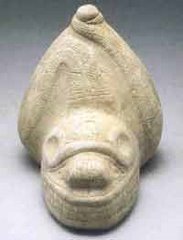
Did You Know - The duho (dujo) is a Taino ceremonial stool or bench that can be made from stone or wood. Traditionally, a duho was usually reserved for community leaders or visiting dignitaries. The duho could be adorned with gold and conch-shell inlay as well as carved with intricate, geometric spiritual motifs. Similar stools are made by the Lokono Arawak, relatives of the Taino, however, they call their benches hala. - UCTP Taino News (c) 2012
Subscribe to:
Posts (Atom)