Thursday, February 04, 2010

Canadian First Nations Recognize Taino Treaty


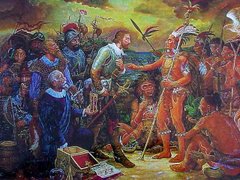
DID YOU KNOW - A peace treaty signed in 1533 in the Caribbean between Taino Kasike Guarokuia (Enriquillo/Henri) and a representative of the King of Spain was recognized as the “first international treaty in the Americas between Indigenous people and Europeans" in a resolution by over 100 delegates to the Assembly of First Nations (AFN) National Treaty Conference, held in Yellowknife, Northwest Territories on Oct. 28, 1998. The AFN resolution recommended recognition of the Taino-Spanish treaty to the United Nations rapporteur, Miguel Alfonso Martinez of Cuba, who was completing his final report on treaties with Indigenous peoples around the world. One fourth of Canada's Indian chiefs attended the conference, which discussed national and international treaty implications and strategies. The resolution, moved by Akaitcho Territory Government Grand Chief Felix Lockhart and seconded by Chief Fred Sangris (Yellowknives Dene), reads in part: "AFN recommends that the "1533 Bahoruco Treaty” be recognized as the first Treaty in the Americas between Indigenous Peoples and Europeans in the Final Report of the U.N. Special Rapporteur.” - © 2010 UCTP Taino News 

References

Alfonso Martínez, M. (1999). Study on treaties, agreements and other constructive arrangements between States and indigenous populations (Final report by the Special Rapporteur, E/CN.4/Sub.2/1999/20). United Nations Economic and Social Council, Commission on Human Rights

Guitar, L. A. (1998). Cultural genesis: Relationships among Indians, Africans, and Spaniards in rural Hispaniola, first half of the sixteenth century. The Americas, 55(3), 419–455.


Friday, January 15, 2010

Taino Recognition


DID YOU KNOW: The United Confederation of Taino People is recognized by the U.S. Congress, U.S. Census Bureau, USA.gov, and several U.S. State and local governments and agencies. In Boriken (Puerto Rico), the Confederation is recognized by the Municipality of Utuado and the Puerto Rican House of Representatives. The work of Confederation is recognized by the Government of Canada and by inter-governmental organizations such as the United Nations and Organization of American States (OAS). In the promotion of indigenous Taino sovereignty, the UCTP has also entered into treaties with Caribbean Indigenous Governments and Tribal Organizations in Dominica, Trinidad, Barbados, and Bermuda as well as with related South American mainland communities in Venezuela and Guyana. - UCTP Taino News ©2010

Thursday, December 17, 2009

The Caribbean


Did You Know: The word “Caribbean” is said to be derived from the name of one of the dominant indigenous (Amerindian) groups in the region at the time of European contact during the late 15th century, the Caribs. While their continues to be debate among scholars as to the origin of the word, at least one of the communities currently identified as "Carib" call themselves Kalinago. The island of Boriken (Puerto Rico) itself was also identified as Carib in some old maps. Some of the other Indigenous Nations identified in the region are Arawak, Ciboney, Galibi, Garifuna, Igneri, Lucayan, and the Taino. - - UCTP Taino News © 2009

Wednesday, November 18, 2009

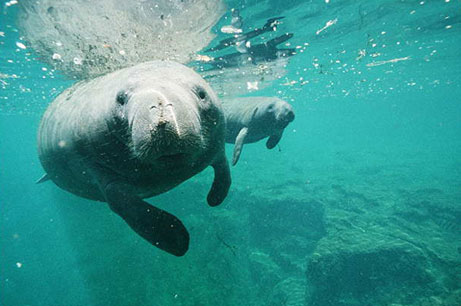
Manatee or Manati


Did you know: Manatees are said to have evolved from four-footed land mammals more than 60 million years ago. According to scientists their closet relatives are reported to be the dugong, and the African Elephant (distantly).There are three species of manatees, including the West Indian manatee. The Florida manatee, which can eat up to 100 pounds (45 kilograms) of vegetation a day and weigh a half-ton on average, is a subspecies of the West Indian manatee. Manatees can move readily between salt water and fresh water, but they can't survive in cold water for long periods. In the U.S. the manatee is still listed federally as an endangered species yet in the state of Florida it it is listed only as a “threatened” species. The word manatee is considered an indigenous "loan word" found in both the Taino and Carib languages. Among the Carib the term Manati is said to translate to mean "breast." Traditionally, the Taino consider this animal as sacred as North American Indigenous Peoples consider the buffalo sacred. Prior to colonization Taino hunters used every part of the animal for food, tools, and other resources. - UCTP Taino News © 2009

Wednesday, October 14, 2009

Tiburon

DID YOU KNOW: The car companies Porsche and Hyundai both have sports cars with Taino names. Porsche has the Cayman which is the Taino word for crocodile (who reside in cays - another Taino word still in use today) and the Hyundai has the Tiburon, which is one of the Taino words for shark. We have yet to see a car named the Manati or the Coki but it's still pretty cool to see our ancient words being used in the modern world. - - UCTP Taino News © 2009

Friday, September 18, 2009

Guaitiao


Did You Know:
Traditionally, the Taino people practiced an elaborate name exchange ceremony to build their family and community alliances. This “making relations” ceremony called GUAITIAO was recorded by early chroniclers where they documented Taino Kasike (chiefs) practicing this custom with Spaniards. Hence, the European took the name of the “Indian”, and vice versa. One of the most renowned of these exchanges was between conquistador Ponce de Leon and a powerful Boriken Chief named Agueibana. The name of the Kasike’s mother was changed to the Spanish doña Inez, and his brother took the name of a captain in Ponce de Leon's company. This exchange of names, accompanied with ceremonies, symbolized a lasting bond that was supposed to link the families together in solidarity for generations. While the Taino respected the Guaitiao custom as sacred, most Spaniards revealed their disregard for it by their actions against the Indigenous Peoples of the islands. – UCTP Taino News © 2009