Thursday, January 03, 2019

El Grito de Koaiuko (Coayuco)

Contemporary representations of Taíno kasike Mabodamaka and Agueibaná "el Bravo" in Borikén (Puerto Rico)

Did You Know:
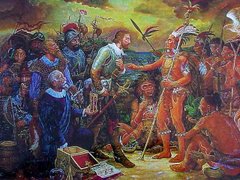
 In Borikén (Puerto Rico), January 3rd is commemorated as the anniversary of “El Grito de Koaiuko (Coayuco)” also known as the Taíno Rebellion of 1511. Two of the main leaders or kasike (chief/s) associated in this uprising were Agüeibaná "el Bravo" and Mabodamaka. According to local history, the kasike (chieftain) Agüeibaná "el Bravo" convened a council with the regional chiefs where they decided to launch a military offensive against the Spanish invaders. An associated attack against Villa Sotomayor was organized and most of the Spaniards who had settled there were killed. Other offensives were not as successful and both Agüeibaná "el Bravo" and Mabodamaka were reported to have been killed by the Spaniards during other battles taking place in Aimako (Aymaco) and Iagüesa (Yagüeza/Yagüeca). 

© 2019 UCTP Taino News 

References

Ponce de León y el descubrimiento de Puerto Rico: El pueblo taíno y su primer choque con los conquistadores. Centro de Estudios Avanzados de Puerto Rico y el Caribe. 

Salvador, E. (2003). Agüeybaná II: El bravo [Encyclopedia entry]. Ediciones Puerto. 

Thursday, September 13, 2018

United Nations Declaration on the Rights of Indigenous Peoples (UNDRIP)

Photo taken right after the adoption of the Declaration on 13 September 2007

Did You Know: The United Nations Declaration on the Rights of Indigenous Peoples (UNDRIP) was adopted by the General Assembly on Thursday, 13 September 2007, by a majority of 144 states in favor, 4 votes against (Australia, Canada, New Zealand and the United States). The Declaration is the most comprehensive international instrument on the rights of Indigenous Peoples. It establishes a universal framework of minimum standards for the survival, dignity and well-being of the Indigenous Peoples of the world and it elaborates on existing human rights standards and fundamental freedoms as they apply to the specific situation of Indigenous Peoples. The United Confederation of Taíno People (UCTP) was among those Indigenous Peoples organizations consistently advocating for the adoption of the Declaration and was a regional leader galvanizing support from the Caribbean States and Caribbean Indigenous Peoples communities, groups, and organizations. UCTP President, R. Múkaro Agueibaná Borrero was in attendance at the United Nations General Assembly Hall the day of the historic adoption. 

© 2018 UCTP Taíno News 

References

Assembly, U. N. G. (2007). United Nations Declaration on the Rights of Indigenous Peoples : resolution / adopted by the General Assembly (A/RES/61/295). United Nations.

Charters, C., & Stavenhagen, R. (Eds.). (2009). Making the declaration work: The United Nations Declaration on the Rights of Indigenous Peoples. IWGIA.


Thursday, August 09, 2018

UN International Day of the World’s Indigenous Peoples

Roberto Múkaro Borrero, holding the
microphone serves as master of ceremonies
for the UN International Day
 of the World's Indigenous Peoples
at UN Headquarters in 1998.
Photo: Holder Thoss

DID YOU KNOW: On 23 December 1994, the United Nations General Assembly decided, in its resolution 49/214, that the International Day of the World's Indigenous Peoples shall be observed on 9 August every year. The date marks the day of the first meeting, in 1982, of the UN Working Group on Indigenous Populations.

The first official observance took place in 1995 at United Nations Headquarters in NY. A Taíno, Roberto Múkaro Borrero, served as the first Master of Ceremonies for the event, representing “El Consejo General de Tainos Borincanos.”

Borrero, filmmaker Alex Zacarias, the Kasibahagua Taíno Cultural Society and other Taíno have since continued to participate in subsequent commemorations of the Day for over 20 years helping to raise the visibility of Taíno and other Caribbean Indigenous Peoples at the international level. 

– © 2018 UCTP Taíno News 

References

United Nations General Assembly. (1994). International Decade of the World's Indigenous People: Resolution / adopted by the General Assembly, 23 December 1994, A/RES/49/214.

United Nations Department of Public Information. (1997). United Nations to observe International day of world's indigenous people, 7-8 August [Press Release No. HR/4322].


Wednesday, March 01, 2017

Guaiaba is Taino

Did You Know: 
Guaiaba 
(Guayaba) is the Taíno word for the guava fruit, which is native to the Caribbean, Central, and South America. The fruit is edible, having a sweet soft interior with a thin delicate rind. The rind varies in color from green to light green or yellow in its mature or "ready to eat" state. When eating guava fruit two things you will notice is that it has small hard seeds as you bite into it as well as a distinctive aroma. Guava is said to be a good source of Vitamins A, B, and C and is a common flavor of juices and desserts in the Caribbean. Guaiaba leaves have been used as a remedy for diarrhea and the leaves are considered to have antimicrobial properties. The same anti-diarrheal substances which are useful in "folk medicine" may also cause constipation in the case of consumption of large amounts of guava fruit. In Cuba, guaiaba leaves are sometimes used in barbecues providing a savory, smoked flavor to the meat. According to Taino oral tradition, the chief or guardian of Koaibei (Coaybey), the Taino spirit world, is named Maketaurie Guaiaba. Taino oral tradition also states that ancestral spirits or hupia leave Koaibei in the evenings, sometimes taking the form of bats who feed on the guaiaba fruit.

© 2017 UCTP Taino News


References

Morton, J. F. (1987). Fruits of Warm Climates. Julia F. Morton.

Arrom, J. J. (1989). Mitología y artes etnología taínas [Taíno Mythology and Arts Ethnology]. Ediciones Panhouse. 

Tuesday, January 03, 2017

The Koaiuko (Coayuco) River


Did You Know: The Rio Yauco in Borikén (Puerto Rico) was originally called the Koaiuko (Coayuco). It was at the mouth of this river that the first recorded battle against the Spaniards was undertaken by Borikua Taíno in 1511 during the first week of January. Many historians state the exact day of the battle was January 3rd. The Spanish chronicler Gonzalo Fernández de Oviedo (1478-1557), in his book "Historia General de las Indias", wrote that "the Christians and the Indians fought the first battle in the land of Agüeybaná at the mouth of the Coayuco River." This reference affirms that the location of the Agüeibaná clan was in the area of the contemporary town of Guayanilla. Local historians have noted that during that time the Rio Yauco flowed into Ventana Beach, in the Boca de Guayanilla neighborhood.

© 2017 UCTP Taino News

References

Brau, S. (1904). Historia de Puerto Rico. D. Appleton y Compañía.

Fernández de Oviedo y Valdés, G. (1851). Historia general y natural de las Indias, islas y tierra-firme del mar océano (J. Amador de los Ríos, Ed.) (Vol. 1). Imprenta de la Real Academia de la Historia. (Original work published 1535) 

Wednesday, December 10, 2014

Múkaro is Taino

Múcaro comun, Puerto Rican Screech owl (Megascops nudipes)

Did You Know: In the ancient language of the indigenous Taino People, the term múkaro (múcaro) identified several species of owl including the Puerto Rican Screech owl (Megascops nudipes) and the Short-eared owl (Múcaro Real - Asio flammeus). A subspecies, M. n . newtoni, is endemic to the Virgin Islands, is more recently referred to locally as the "cuckoo bird." The múkaro (pronounced mOO-kah-roh) is a small-sized owl possessing a brown upperside, a light-brown to white underside, white brown lines and white eyebrows. The main diet of the species consists of large insects and is complemented with small birds, geckos and small rodents. The species calls throughout the year while hidden in thick foliage, typically at dawn. The múkaro makes a loud coo-coo call, which is the reason for its common name in the Virgin Islands. Contrary to modern folklore giving owls a negative reputation, most owls were traditionally revered by the Taino and they are one of the most popular bird motifs depicted via petroglyphs (rock carvings). Taino names for other owls include “Siguapa” (Stygian Owl - Asio stygius) and “Sihú (Sijú)”, which is used to identify the Cuban Bare-legged owl (Sijú Contunto - Margarobyas lawrencii lawrencii) and the Cuban pygmy-owl (the Sijú platanero; Sijucito; Sijú - Glaucidium vittatum).

– 
© 2014 UCTP Taino News 

References

Diccionario de Voces Indígenas de Puerto Rico by Luis Hernández Aquino (published in 1977)

Las Aves de Puerto Rico by Virgilio Biaggi (published in 1983)