Thursday, December 17, 2009

The Caribbean


Did You Know: The word “Caribbean” is said to be derived from the name of one of the dominant indigenous (Amerindian) groups in the region at the time of European contact during the late 15th century, the Caribs. While their continues to be debate among scholars as to the origin of the word, at least one of the communities currently identified as "Carib" call themselves Kalinago. The island of Boriken (Puerto Rico) itself was also identified as Carib in some old maps. Some of the other Indigenous Nations identified in the region are Arawak, Ciboney, Galibi, Garifuna, Igneri, Lucayan, and the Taino. - - UCTP Taino News © 2009

Wednesday, November 18, 2009

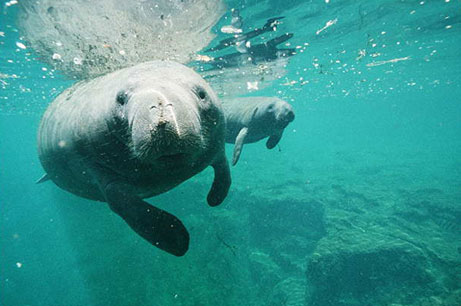
Manatee or Manati


Did you know: Manatees are said to have evolved from four-footed land mammals more than 60 million years ago. According to scientists their closet relatives are reported to be the dugong, and the African Elephant (distantly).There are three species of manatees, including the West Indian manatee. The Florida manatee, which can eat up to 100 pounds (45 kilograms) of vegetation a day and weigh a half-ton on average, is a subspecies of the West Indian manatee. Manatees can move readily between salt water and fresh water, but they can't survive in cold water for long periods. In the U.S. the manatee is still listed federally as an endangered species yet in the state of Florida it it is listed only as a “threatened” species. The word manatee is considered an indigenous "loan word" found in both the Taino and Carib languages. Among the Carib the term Manati is said to translate to mean "breast." Traditionally, the Taino consider this animal as sacred as North American Indigenous Peoples consider the buffalo sacred. Prior to colonization Taino hunters used every part of the animal for food, tools, and other resources. - UCTP Taino News © 2009

Wednesday, October 14, 2009

Tiburon

DID YOU KNOW: The car companies Porsche and Hyundai both have sports cars with Taino names. Porsche has the Cayman which is the Taino word for crocodile (who reside in cays - another Taino word still in use today) and the Hyundai has the Tiburon, which is one of the Taino words for shark. We have yet to see a car named the Manati or the Coki but it's still pretty cool to see our ancient words being used in the modern world. - - UCTP Taino News © 2009

Friday, September 18, 2009

Guaitiao


Did You Know:
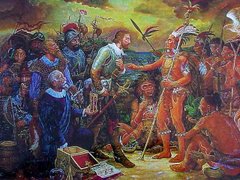
Traditionally, the Taino people practiced an elaborate name exchange ceremony to build their family and community alliances. This “making relations” ceremony called GUAITIAO was recorded by early chroniclers where they documented Taino Kasike (chiefs) practicing this custom with Spaniards. Hence, the European took the name of the “Indian”, and vice versa. One of the most renowned of these exchanges was between conquistador Ponce de Leon and a powerful Boriken Chief named Agueibana. The name of the Kasike’s mother was changed to the Spanish doña Inez, and his brother took the name of a captain in Ponce de Leon's company. This exchange of names, accompanied with ceremonies, symbolized a lasting bond that was supposed to link the families together in solidarity for generations. While the Taino respected the Guaitiao custom as sacred, most Spaniards revealed their disregard for it by their actions against the Indigenous Peoples of the islands. – UCTP Taino News © 2009

Thursday, August 27, 2009

Iuka or Yuca or Cassava?


Did You Know: Iuka (yuca), also known as cassava or manioc (Manihot esculenta) , is a starch rich plant, which thanks to the Taino People is now grown worldwide. Iuka is a part of the Euphorbiaceae family, and its roots are described as long with a thick brown rind that encases the edible part. Cassava is major source of carbohydrates, and it contains large amounts of calcium, phosphorous, and Vitamin C. Unfortunately, iuka is very low in protein and other important nutrients. An interesting fact about this root tuber is that it in fact contains small traces of cyanide; in some cases from about 20 milligrams and above. Boiling the root will eliminate the toxicity. Iuka can be prepared and eaten in many ways. Cassava bread or kasabi/kasabe, a traditional crispy flat bread made by Taíno and other Indigenous Peoples of the region is still popular throughout the Caribbean. It is eaten with fruit spreads, butter, or a variety of other foods. Boiling the root is the most common way of eating iuka, and it can be a replacement for potatoes or plantains during meals. Iuka can also be used as a replacement for potatoes in dishes such as purees, dumplings, gnocchi, stews, or soups and it is the main ingredient in Tapioca. Traditionally, iuka is believed to have anti-inflammatory and anti-viral properties and is sometimes used to treat arthritis, stomach disorders and even diabetes. © 2009 UCTP Taino News 


Iuka (yuca) root tubers

References

Coker, R. D., Nagler, M. J., & Blunden, G. (2004). The processing of cassava to reduce cyanogens. Journal of the Science of Food and Agriculture, 84(6), 591–595.

Cardoso, A. P., Mirione, E., Ernesto, M., Massaza, F., Cliff, J., Reza, F., & Bradbury, J. H. (2005). Processing of cassava roots to remove cyanogens. Journal of Food Composition and Analysis, 18(5), 451–460.

Saturday, July 25, 2009

Taino Agricultural Science

Did You Know: The Taino developed an agricultural science based on an intimate knowledge of the world around them? For example, when planting iuka (yuca/manioc, cassava) Taino traditionally follow the lunar cycle. Why is this done? The moon phase cycle is followed because there are certain insects predators like the Bibijagua (black ants) and others who like to eat young iuka plants. These insects usually prefer to hunt during the full moon and are either dormant or less active during the “waning” moon period. When iuka plants are young they have little defenses to ward off natural enemies. The Taino planted iuka during the waning moon to allow time for the plants natural toxin defenses to develop. – UCTP Taino News © 2009