Did You Know: A flat forehead was considered very attractive in many Taino communities. Mothers carried their newborn babies on their backs with a padded, wooden board. The board would lay across the child's head and flattened the impressionable forehead.- - UCTP Taino News © 2009
Wednesday, May 06, 2009


Tuesday, April 21, 2009
The West Indian Boa: MAHA
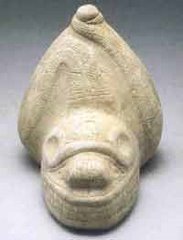
 Did You Know: West Indian boas (Epicrates) snakes that are found throughout the Caribbean islands. In the Major Antilles, some species are still known by their Taino name MAHA (Maja). These snakes range in size and coloration. Maha are primarily ground-dwellers, although they may also climb trees. On several Caribbean islands Maha gather at cave entrances at night, snatching bats out of the air as they exit or enter the cave. As in other boas, the Maha young feed on small animals such as lizards, whereas the large adults tend to feed on larger mammals and birds. Generally speaking, each island has a single, unique species. The exception is the island of Kiskeia (Haiti and the Dominican Republic), which has three species. The Cuba Boa is one of the largest of the boa group or genus and it is the primary predator of the hutia (Capromys Pilorides), an indigenous island rodent. Like many Maha, they are endangered today not only by natural phenomenum like hurricanes but also from deforestation. Maha also also endanger from local island residents who kill these snakes thinking they are a threat to poultry. The Maha can be seen depicted in ancient Taino art forms from stone work to wood and clay. For the ancient Taino, the Maha was not seen as an ill omen but part of the nature world with its own unique lessons to share. - - UCTP Taino News © 2009
Saturday, March 07, 2009
The Antillean Nighthawk


Did You Know: The Antillean Nighthawk (Chordeiles gundlachii), also known as the Cuban Nightjar, is a species of nightjar in the Caprimulgidae family. It is known as querequeté in Kuba, querebebé in the Dominican Republic, and querequequé in Puerto Rico and is commonly found through the Greater Antilles, as well as the Bahamas and the Virgin Islands. Its natural habitats are subtropical or tropical moist lowland forests and subtropical or tropical moist montanes. Like owls, they are nocturnal hunters with a highly developed sense of sight, and like the swifts they are excellent flyers with small, weak legs. A rare related species, Caprimulgus noctitherus, exists in the coastal dry scrub forests of southwestern Puerto Rico and is in danger of extinction. Locally, the Puerto Rican nightjar is still known by its Taino name Guabairo. - UCTP Taino News © 2009
Sunday, February 08, 2009
Guanaro
 Did You Know: The Zenaida Dove (Zenaida aurita) is a member of the bird family Columbidae, which includes doves and pigeons. It is the national bird of Anguilla, where it is often but erroneously referred to as a Turtle Dove. The Zenaida Dove breeds throughout the Caribbean and the tip of the Yucatán Peninsula. Its mournful cooOOoo-coo-coo-coo call is similar to the call of a Mourning Dove, but faster in pace. In some parts of the Major Antilles the Zenaida Dove is still commonly known by its Taino name Guanaro. - - UCTP Taino News © 2009
Sunday, January 04, 2009
Guareao

Did You Know: The Limpkin (Aramus guarauna) is a large bird that makes its home from Florida to Mexico and on through parts of South America and the Caribbean. In the Greater Antilles this bird is still commonly known by it Taino name Guareao. Its plumage is dark brown with an olive luster above. The feathers of the Guareao's head, neck, wing coverts, and much of the back and underparts (except the rear) are streaked with white. It has long, dark-gray legs and a long neck. Its bill is long, heavy, and downcurved, yellowish bill with a darker tip. The Guareao is easier to hear than see. Its common vocalization is a loud wild wail with some rattling quality, represented as "kwEEEeeer or klAAAar." This call is most often given at night and at dawn and dusk. The call of the Guareao has been used for jungle sound effects in Tarzan films and for the hippogriff in the film Harry Potter and the Prisoner of Azkaban. - - UCTP Taino News © 2009
Thursday, December 11, 2008
Taino Weaving

Did You Know - Weaving techniques for making haba (baskets), makuto (pack sacks), and hamaka (hammocks) formed an important part of ancient Taino culture. Even Christopher Columbus remarked on the finely woven cotton blankets made by the Taino during his early encounters with the island communities. Today, many of the same weaving techniques are still used by contemporary communities throughout the Caribbean. – - UCTP Taino News © 2008
Subscribe to:
Posts (Atom)