Did You Know: The cashew tree (Anacardium occidentale) is said to have originated in northeast Brazil, however, it
is widely distributed through tropical South and Central America and the
Caribbean. In Borikén (Puerto Rico) and Kiskeia (Dominican Republic), what are
understood to be Taino words for cashew are still used today, incorporated in
the local Spanish language including kahuil (prounounced kah-hoo-eel), pahuil (pajuil), and pauhil. An
additional, more rarely used term for cashew in Borikén is pahui (pajuy/pah-hoo-ee). All
these terms seem to be related linguistically to the term for cashew used in indigenous
Tupian languages - acajú
- said to mean
“nut that produces itself.” The cashew tree is large and evergreen, growing to
10-12m (32 ft) tall. It produces a type of fruit (known in English as ‘cashew
apple’ or ‘marañón’
in Spanish), which is edible, and has a strong "sweet" smell
and a sweet taste. The cashew nut is really a seed and a good source of
antioxidants, but it needs to be roasted or steamed as it contains urushiol, a resin that can cause skin rashes, and can be toxic when ingested. Urushiol is also present in the tree's leaves. Traditional medicinal uses of the cashew tree include grinding the
seeds into a poultice for treating snakebites, and the use of the fruit, bark, and leaves for
many other purposes including anti-fungal activity, for sores and rashes, or as
an antipyretic, and for antidiarrheal applications. – UCTP Taino News © 2014
Monday, March 17, 2014
Cashews and Taino People
Sunday, February 09, 2014
Semí is Taíno
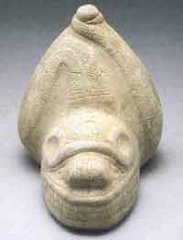
Did You Know: In Taíno culture, a semí (cemi, zemi) is a deity, an ancestral
spirit, or a spiritual manifestation representing a specific aspect of or an
element of nature. Pronounced seh-mee,
the word can also refer to a sacred physical icon that represents a spirit or deity,
which traditionally can be presented in wood, bone, shell, clay, cotton,
beadwork, or stone. Some academics have promoted the word as 'zemi,' however;
this is a corrupted version of the Taíno word based on the imposition of the
Spanish language. In the related Lokono Arawak language the word “semee” is
associated to the concept of sweetness while “semechichi” refers to a community healer.
Similar versions of the word/concept semí also appear in other neighboring and related languages.
In the eyeri/igneri/ieri
language, for instance, the equivalent word is 'chemín' while in the insular carib or Kalinago language we find 'chemíjn,' sometimes
written as 'semígn.' – UCTP Taino News © 2014
Saturday, January 04, 2014
Kokuio (Cocuyo) is Taino
DID
YOU KNOW: The word kokuio (cocuyo) is a Taino word for firefly, an insect
in the Lampyridae family of the beetle order Coleoptera. These beetles are special in that most of
them have the ability to produce light called bioluminescence. In English, they
are sometimes called 'lightning bugs' or 'forest stars'. There are about 2000
different species, most of which are nocturnal. Adults use flashes of light to
attract mates. Also, firefly larvae flash their lights to warn predators that
they are not a tasty meal. Many predators do not like the taste of firefly
larvae. It is said that, traditionally, when Taino people would capture
fireflies they would use a torch and call out “kokuio, kokuio!” After the koukio were captured, they were
released inside the home of a Taino. The kokuio
is a natural predator of mosquitos, which is very helpful in the Caribbean. Kokuio were also sometimes used inside
homes as lanterns to assist when individuals were weaving and engaging in other
activities in the home at night. Sometimes, mischievous Taino children were known to smear ground kokuio paste on their faces to scare their peers. On the island of Borikén, along with the word kokuio, the Taino word kukubano is also used to describe
fireflies. – UCTP Taino News © 2014
Thursday, December 19, 2013
Hikotea is Taino
Did
You Know: “Hikotea” (jicotea) is a Taino word for various land and fresh water
turtles. The term hikotea (hee-koh-teh-ah) is still used throughout the Greater Antilles to
identify these turtles. In ancient times the hikotea was directly linked to Taino
creation, as the primordial mother of the people was a turtle who transformed
into a woman. As a result of this ancestral distinction, many persons still
view it as an offense to kill or eat a fresh water or land turtle. A further
spiritual distinction of the hikotea is that it carries the numbers of a sacred calendar
of the people on its shell. Patterns on the outer edge of its shell coincide
with the sacred lunar calendar cycle of 28 days from full moon to full moon.
The hikotea’s additional shell patterns correspond with the 13 moons of the
lunar year. - UCTP Taino News (c) 2013
Thursday, November 14, 2013
Guaio (guayo) is Taino
DID YOU KNOW: The word guaio (guayo) is a Taino
term used to identify a grater used in food production. Pronounced gwa-ee-o, the
word has been incorporated into regional Spanish dialects even beyond the noun, guayo, into the verb “guayar” meaning “to grate.” Traditionally, a guaio would
be made from a slab of wood with sharp, small stones pounded into it, coral slabs,
or stones slabs with various perforations, etc.
These various forms of guaio were often artistically elaborated. – UCTP
Taino News © 2013
Subscribe to:
Posts (Atom)