Did You Know:
The peanut plant originated in South America, but it was seen for the first time by Europeans in the Caribbean. Bartolome de las Casas was the first European to document the peanut plant. He noted that the Taino people often ate peanuts with casabe (cassava bread). Early Spanish galleons introduced peanuts to the Pacific Islands, the Philippines, and Indonesia. By the early 1600's, peanuts were introduced to Malaysia, Vietnam, China, and Japan. India acquired the peanut from several routes in the 18th century: from Africa to Western India, from Manila to South India, from China to Bengal. The earliest documented account of peanuts in the North American British colonies is 1769. The Taino word for peanut is maní. - UCTP Taino News © 2014
Tuesday, July 08, 2014
Saturday, June 07, 2014
Kakata is Taino
Caribbean tarantula or kakata found in Borikén (Puerto Rico). Photo by Alfredo Colon
Did You Know: Caribbean tarantulas are found throughout the Caribbean islands and are a part of the 'New World" tarantula group. The indigenous Taino word for tarantula is kakata (cacata). The bite of a kakata is not fatal to humans even though it does posses venom. Kakata have defensive, urticating hairs, which cause itching and discomfort when harassed. The male kakata can usually be seen in the open, as they often are in search of mates. Females are also visible, but tend to stay near their homes. Some kakata are burrowing while others construct nest made of webs in trees. In the Taíno language, word kakata means to "mix" as with the hands, which brings to mind the movement of this large and hairy arachnid. - UCTP Taino News © 2014
Tuesday, May 06, 2014
Hibá is Taino
Did You Know: The Hibá
(Jibá),
Erythroxylon havanense, is a flowering shrub found in Kuba and other
islands of the Caribbean. This plant retains its indigenous Taino name, Hibá,
and according to local healing traditions, the stems and leaves are good for
the kidney and liver disorders. A concoction made from hibá roots is said to be a powerful diuretic.
– UCTP Taino News © 2014
Friday, April 04, 2014
Hikí is Taino
Did You Know: The Hikí (jiquí, jigi, jequí), Pera bumeliaefolia; P. bumeliifolia, is a tree endemic to some Caribbean islands and known for its hard wood and moisture resistance. The tree retains it Taino name, Hikí, which sounds like “hee-kEE.” Archeologists in Kuba have found ancient Taino artifacts such as sculptures and axe handles made of this wood. According to local healing traditions, the astringent quality of this tree’s bark can be used to treat certain skin conditions. – UCTP Taino News © 2014Monday, March 17, 2014
Cashews and Taino People
Did You Know: The cashew tree (Anacardium occidentale) is said to have originated in northeast Brazil, however, it
is widely distributed through tropical South and Central America and the
Caribbean. In Borikén (Puerto Rico) and Kiskeia (Dominican Republic), what are
understood to be Taino words for cashew are still used today, incorporated in
the local Spanish language including kahuil (prounounced kah-hoo-eel), pahuil (pajuil), and pauhil. An
additional, more rarely used term for cashew in Borikén is pahui (pajuy/pah-hoo-ee). All
these terms seem to be related linguistically to the term for cashew used in indigenous
Tupian languages - acajú
- said to mean
“nut that produces itself.” The cashew tree is large and evergreen, growing to
10-12m (32 ft) tall. It produces a type of fruit (known in English as ‘cashew
apple’ or ‘marañón’
in Spanish), which is edible, and has a strong "sweet" smell
and a sweet taste. The cashew nut is really a seed and a good source of
antioxidants, but it needs to be roasted or steamed as it contains urushiol, a resin that can cause skin rashes, and can be toxic when ingested. Urushiol is also present in the tree's leaves. Traditional medicinal uses of the cashew tree include grinding the
seeds into a poultice for treating snakebites, and the use of the fruit, bark, and leaves for
many other purposes including anti-fungal activity, for sores and rashes, or as
an antipyretic, and for antidiarrheal applications. – UCTP Taino News © 2014
Sunday, February 09, 2014
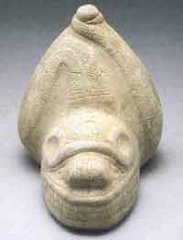
Semí is Taíno
Did You Know: In Taíno culture, a semí (cemi, zemi) is a deity, an ancestral
spirit, or a spiritual manifestation representing a specific aspect of or an
element of nature. Pronounced seh-mee,
the word can also refer to a sacred physical icon that represents a spirit or deity,
which traditionally can be presented in wood, bone, shell, clay, cotton,
beadwork, or stone. Some academics have promoted the word as 'zemi,' however;
this is a corrupted version of the Taíno word based on the imposition of the
Spanish language. In the related Lokono Arawak language the word “semee” is
associated to the concept of sweetness while “semechichi” refers to a community healer.
Similar versions of the word/concept semí also appear in other neighboring and related languages.
In the eyeri/igneri/ieri
language, for instance, the equivalent word is 'chemín' while in the insular carib or Kalinago language we find 'chemíjn,' sometimes
written as 'semígn.' – UCTP Taino News © 2014
Subscribe to:
Posts (Atom)