Thursday, August 27, 2009

Iuka or Yuca or Cassava?


Did You Know: Iuka (yuca), also known as cassava or manioc (Manihot esculenta) , is a starch rich plant, which thanks to the Taino People is now grown worldwide. Iuka is a part of the Euphorbiaceae family, and its roots are described as long with a thick brown rind that encases the edible part. Cassava is major source of carbohydrates, and it contains large amounts of calcium, phosphorous, and Vitamin C. Unfortunately, iuka is very low in protein and other important nutrients. An interesting fact about this root tuber is that it in fact contains small traces of cyanide; in some cases from about 20 milligrams and above. Boiling the root will eliminate the toxicity. Iuka can be prepared and eaten in many ways. Cassava bread or kasabi/kasabe, a traditional crispy flat bread made by Taíno and other Indigenous Peoples of the region is still popular throughout the Caribbean. It is eaten with fruit spreads, butter, or a variety of other foods. Boiling the root is the most common way of eating iuka, and it can be a replacement for potatoes or plantains during meals. Iuka can also be used as a replacement for potatoes in dishes such as purees, dumplings, gnocchi, stews, or soups and it is the main ingredient in Tapioca. Traditionally, iuka is believed to have anti-inflammatory and anti-viral properties and is sometimes used to treat arthritis, stomach disorders and even diabetes. © 2009 UCTP Taino News 


Iuka (yuca) root tubers

References

Coker, R. D., Nagler, M. J., & Blunden, G. (2004). The processing of cassava to reduce cyanogens. Journal of the Science of Food and Agriculture, 84(6), 591–595.

Cardoso, A. P., Mirione, E., Ernesto, M., Massaza, F., Cliff, J., Reza, F., & Bradbury, J. H. (2005). Processing of cassava roots to remove cyanogens. Journal of Food Composition and Analysis, 18(5), 451–460.

Saturday, July 25, 2009

Taino Agricultural Science

Did You Know: The Taino developed an agricultural science based on an intimate knowledge of the world around them? For example, when planting iuka (yuca/manioc, cassava) Taino traditionally follow the lunar cycle. Why is this done? The moon phase cycle is followed because there are certain insects predators like the Bibijagua (black ants) and others who like to eat young iuka plants. These insects usually prefer to hunt during the full moon and are either dormant or less active during the “waning” moon period. When iuka plants are young they have little defenses to ward off natural enemies. The Taino planted iuka during the waning moon to allow time for the plants natural toxin defenses to develop. – UCTP Taino News © 2009

Wednesday, June 24, 2009

Taino Higuera Gourd Use

Did You Know: The Taínos people used Higuera or calabash gourds for many daily activities. Higuera (Crescentia cujete) were used as containers for food storage, for washing food, drinking and holding water. The higuera was also used to make eating utensils, and the contents of certain gourds were even used as medicine. One ingenious use of the larger higuera was for hunting waterfowl. Taíno hunters would place gourds in the water as decoys so the waterfowl would land on or near them. Once the waterfowl became used to the presence of gourds in the water, the Taíno would strap gourds on top of their head and slowly enter the water. They would swim among the birds and floating gourds without being spotted. Then, they would grab the waterfowl by the neck or the feet and drown them. Finally, higuera were also used for ceremonial activities as special containers or in the construction of maraka (rattles). – UCTP Taino News © 2009

Wednesday, May 06, 2009

Flat Foreheads

Did You Know: A flat forehead was considered very attractive in many Taino communities. Mothers carried their newborn babies on their backs with a padded, wooden board. The board would lay across the child's head and flattened the impressionable forehead.- - UCTP Taino News © 2009

Tuesday, April 21, 2009

The West Indian Boa: MAHA

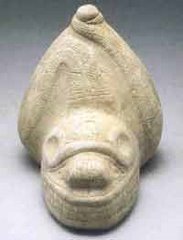
Did You Know: West Indian boas (Epicrates) snakes that are found throughout the Caribbean islands. In the Major Antilles, some species are still known by their Taino name MAHA (Maja). These snakes range in size and coloration. Maha are primarily ground-dwellers, although they may also climb trees. On several Caribbean islands Maha gather at cave entrances at night, snatching bats out of the air as they exit or enter the cave. As in other boas, the Maha young feed on small animals such as lizards, whereas the large adults tend to feed on larger mammals and birds. Generally speaking, each island has a single, unique species. The exception is the island of Kiskeia (Haiti and the Dominican Republic), which has three species. The Cuba Boa is one of the largest of the boa group or genus and it is the primary predator of the hutia (Capromys Pilorides), an indigenous island rodent. Like many Maha, they are endangered today not only by natural phenomenum like hurricanes but also from deforestation. Maha also also endanger from local island residents who kill these snakes thinking they are a threat to poultry. The Maha can be seen depicted in ancient Taino art forms from stone work to wood and clay. For the ancient Taino, the Maha was not seen as an ill omen but part of the nature world with its own unique lessons to share. - - UCTP Taino News © 2009

Saturday, March 07, 2009

The Antillean Nighthawk


Did You Know: The Antillean Nighthawk (Chordeiles gundlachii), also known as the Cuban Nightjar, is a species of nightjar in the Caprimulgidae family. It is known as querequeté in Kuba, querebebé in the Dominican Republic, and querequequé in Puerto Rico and is commonly found through the Greater Antilles, as well as the Bahamas and the Virgin Islands. Its natural habitats are subtropical or tropical moist lowland forests and subtropical or tropical moist montanes. Like owls, they are nocturnal hunters with a highly developed sense of sight, and like the swifts they are excellent flyers with small, weak legs. A rare related species, Caprimulgus noctitherus, exists in the coastal dry scrub forests of southwestern Puerto Rico and is in danger of extinction. Locally, the Puerto Rican nightjar is still known by its Taino name Guabairo. - UCTP Taino News © 2009