Thursday, August 22, 2013

The Stingray and Taino Culture


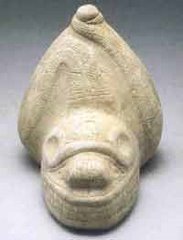
Did You Know: Since ancient times, stingrays have been a part of the Caribbean’s marine environment and the cultures of the region’s Indigenous Peoples. Taíno and other Caribbean Indigenous Peoples, for example, would traditionally use the barbed spine located toward the bottom of a stingray’s tail in various ways. Stingray barbs would sometimes be used as tips for spears and arrows used for hunting or weapons, as well as for adornments like necklaces and bracelets. Like sharkskin, the rough skin of certain stingrays were also used as a grating tool to grind iuka (yuca/cassava/manioc) into a fine powder.  Some Taino words for stingrays include Libusa, Lebisa, Sabina, and Chucho (spotted eagle ray). - UCTP Taino News © 2013

Wednesday, July 10, 2013

Arepa and the Taino


Did You Know: An arepa is a flat corn bread patty developed by Indigenous Peoples in Northern South America, but its use has spread throughout the Caribbean region for generations. An arepa can be made fresh or with dried corn, which is ground into flour and made into dough that can be cooked in different ways. If dried corn kernels are used, however, they are boiled and soaked in water over night to breakdown the “hull” of the corn. Some Indigenous Peoples' communities also add ground limestone or ashes to breakdown the hull. The term arepa is incorporated in the Taíno language today, but it is actually a “loan word” with its linguistic origin coming from the language of the Karina or “true” Carib peoples of mainland South America. – UCTP Taino News © 2013


Sunday, June 30, 2013

Batea is Taino


Did You Know: Batea are oval or circular wooden trays used traditionally by Taino to carry food, wash clothes, or pan for gold. Today, Taino and others in Kiskeia (Dominican Republic) continue to make and use them for these same purposes, still calling them batea, which is its Taino name. Batea is pronounced  "bah-teh-ah." - UCTP Taino News (c) 2013 

Tuesday, April 09, 2013

On the term Taino


Did You Know: The term “Taíno” appears at least twice in the historical record as a term used by Taíno Peoples to describe themselves collectively. In one instance, Dr. Diego Álvarez Chanca reported that, on an island near Guadeloupe, Indigenous women and men from Borikén (Puerto Rico) used the word Taíno to differentiate themselves from other Indigenous Peoples in the area. Chanca was an eyewitness to the encounter.

In a second introductory encounter, Melchior Maldonado was exploring Kiskeia (Dominican Republic) when a group of Taíno men, led by an elder, also used the term Taíno. This event was recorded by Peter Martyr d’Anghiera, who received the information from an eyewitness.

While Chanca interpreted Taíno to mean “good,” d’Anghiera translated it as “good men,” which is closer to the fuller interpretation of “good people.” Although the historical record shows that Taíno ancestors used various local, regional, and relational identifiers, it also confirms that Taíno was among the terms they used to identify themselves collectively.

— © 2013 UCTP Taíno News


References

d'Anghiera, P. M. (1912). De Orbe Novo: The eight decades of Peter Martyr D'Anghera (F. A. MacNutt, Trans.). G. P. Putnam's Sons. (Original work published 1530)

Álvarez Chanca, D. (1907). The letter of Dr. Diego Alvarez Chanca, dated 1494, relating to the second voyage of Columbus to America. In A. B. Hulbert (Ed.), The Crown Collection of Photographs of American Maps (Ser. II, Vol. 3). Smithian Institution / (Original letter written 1494)

Friday, March 08, 2013

Taino Flag


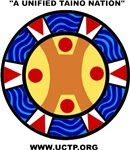
Did You Know: The flag of the United Confederation of Taíno People (UCTP) represents Taíno people “reaching out in solidarity” across the Caribbean Sea in all the sacred directions wherever their relatives can be found.  The original flag symbol was created in 1997 for the UCTP by artist Marie Crooke and further elaborated by artist Joe Leon. The UCTP flag is a part of the permanent collections of and displayed at the Smithsonian’s National Museum of the American Indian in Washington, D.C.; the Mashantucket Pequot Museum in Connecticut; the Institute of American Indian Arts in New Mexico; the Virgin Islands National Parks Service; and the Sami Parliament in Norway.  – UCTP Taino News (c) 2013

Sunday, February 17, 2013

Taíno Political Organization


Did You Know: Taíno society was organized in two sectors - nitaíno (community leaders) and naboria (general community members).  Community life was administrated by chiefs and sub-chiefs called kasike (cacique), who in turn were supported and often advised by other community and spiritual leaders called behike and buhiti among other names. The traditional territories (called cacicazgos by the Spaniards) controlled by kasike were actually confederations of iukaieke (yucayeque) communities with populations that ranged from several hundred to thousands of people. As Taíno society developed over time, powerful kasike (caciques) united these communities into political states that were ultimately guided by a grand or paramount chief. In 1492, Kiskeia (Hispaniola) was organized under five confederations. Boriken (Puerto Rico) was organized under 20, with the Guainia (Guaynia) territory being the largest and most politically powerful. -  UCTP Taíno News © 2013