Showing posts with label Kasike. Show all posts

Saturday, August 17, 2019

Areito is Taíno

Members of the Kasibahagua Taíno Cultural Society shared a contemporary areito
 at the 2019 Bear Mountain Pow Wow in New York. 

Did You Know: The term areito (also spelled areyto) is a Taíno word that describes a socio-ceremonial blend of dance, music, song, and poetry. The areito played a significant role in the social, political, and religious life of the Taíno People. In the 15th and early 16th century, Spanish chroniclers in the Caribbean noted that the arieto were presented in the main plaza of the iukaieke (also spelled yucayeque) or village. Sometimes areito were conducted in a designated area in front of the home of a kasike or chieftain. These plazas or ceremonial grounds called batei had their borders defined by standing stones, often decorated or carved with various images, or by earthen embankments.

Dances during an areito could vary a great deal. Sometimes there were step-patterns moving along specific pathways. Walking patterns that went no more than a step or two in either direction were also used. According to a few of the descriptions given by Spanish chroniclers, some dances were comparable to what would be called line dances today. All the dances were lead by a tekina (a guide, teacher or dance master) of either sex who would use a call and response pattern of song and steps. Areito leaders determined the steps, words, rhythm, energy, tone, and pitch of a dance sequence. The dances could be based on ancient clearly choreographed steps or new choreography could be presented in this evolving art form. 
- © 2019 UCTP Taíno News 

References

Maestri, N. Areitos: Ancient Caribbean Taíno Dancing and Singing Ceremonies, ThoughtCo., https://www.thoughtco.com/areitos-ceremony-169589 

Atkinson L-G. 2006. The Earliest Inhabitants: The Dynamics of the Jamaican Taino. Kingston, Jamaica: University of West Indies Press. 

León T. 2016. Polyrhythmia in the Music of Cuba. Polyrhythmia in the Music of Cuba. Diagonal: An Ibero-American Music Review 1(2). 

Saunders NJ. 2005. The Peoples of the Caribbean. An Encyclopedia of Archaeology and Traditional Culture. Santa Barbara, California: ABC-CLIO. Scolieri PA. 2013. On the Areito: Discovering Dance in the New World. Dancing the New World: Aztecs, Spaniards, and the Choreography of Conquest. University of Texas Press: Austin. p 24-43. 

Simmons ML. 1960. Pre-Conquest Narrative Songs in Spanish America. The Journal of American Folklore 73(288):103-111. 

Thompson D. 1983. Music Research in Puerto Rico. College Music Symposium 23(1):81-96. 

Thompson D. 1993. The "Cronistas de Indias" Revisited: Historical Reports, Archeological Evidence, and Literary and Artistic Traces of Indigenous Music and Dance in the Greater Antilles at the Time of the "Conquista". Latin American Music Review / Revista de Música Latinoamericana 14(2):181-201.  

Wilson SC. 2007. The Archaeology of the Caribbean. New York: Cambridge University Press.

Sunday, February 17, 2013

Taíno Political Organization


Did You Know: Taíno society was organized in two sectors - nitaíno (community leaders) and naboria (general community members).  Community life was administrated by chiefs and sub-chiefs called kasike (cacique), who in turn were supported and often advised by other community and spiritual leaders called behike and buhiti among other names. The traditional territories (called cacicazgos by the Spaniards) controlled by kasike were actually confederations of iukaieke (yucayeque) communities with populations that ranged from several hundred to thousands of people. As Taíno society developed over time, powerful kasike (caciques) united these communities into political states that were ultimately guided by a grand or paramount chief. In 1492, Kiskeia (Hispaniola) was organized under five confederations. Boriken (Puerto Rico) was organized under 20, with the Guainia (Guaynia) territory being the largest and most politically powerful. -  UCTP Taíno News © 2013

Thursday, February 04, 2010

Canadian First Nations Recognize Taino Treaty


DID YOU KNOW - A peace treaty signed in 1533 in the Caribbean between Taino Kasike Guarokuia (Enriquillo/Henri) and a representative of the King of Spain was recognized as the “first international treaty in the Americas between Indigenous people and Europeans" in a resolution by over 100 delegates to the Assembly of First Nations (AFN) National Treaty Conference, held in Yellowknife, Northwest Territories on Oct. 28, 1998. The AFN resolution recommended recognition of the Taino-Spanish treaty to the United Nations rapporteur, Miguel Alfonso Martinez of Cuba, who was completing his final report on treaties with Indigenous peoples around the world. One fourth of Canada's Indian chiefs attended the conference, which discussed national and international treaty implications and strategies. The resolution, moved by Akaitcho Territory Government Grand Chief Felix Lockhart and seconded by Chief Fred Sangris (Yellowknives Dene), reads in part: "AFN recommends that the "1533 Bahoruco Treaty” be recognized as the first Treaty in the Americas between Indigenous Peoples and Europeans in the Final Report of the U.N. Special Rapporteur.” - © 2010 UCTP Taino News 

References

Alfonso Martínez, M. (1999). Study on treaties, agreements and other constructive arrangements between States and indigenous populations (Final report by the Special Rapporteur, E/CN.4/Sub.2/1999/20). United Nations Economic and Social Council, Commission on Human Rights

Guitar, L. A. (1998). Cultural genesis: Relationships among Indians, Africans, and Spaniards in rural Hispaniola, first half of the sixteenth century. The Americas, 55(3), 419–455.


Wednesday, October 15, 2008

Taino Regalia


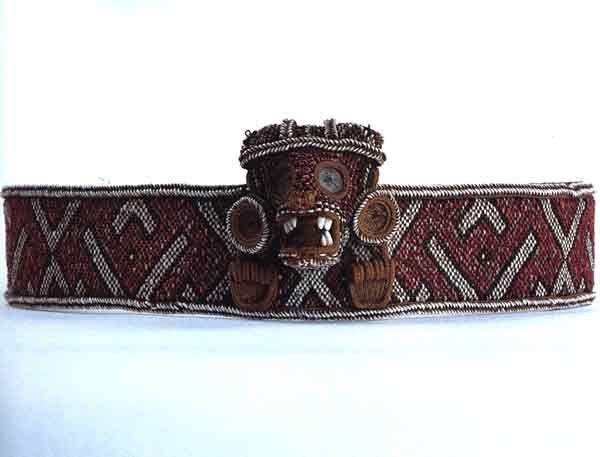
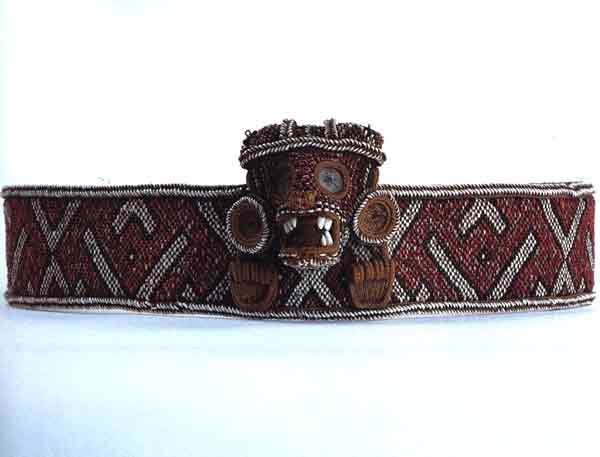
Did You Know - Taino Kasike (Chiefs) and nitaíno (community leaders) distinguished themselves with their clothing, regalia, jewelry, and other accessories. They wore garments of the finest woven sarobei (sarobey) cotton and beaded belts with geometric designs. For important occasions they sometimes donned capes made from the colorful plumage of tropical birds: parrots, flamingos, herons, and hawks, etc. Traditionally, beautifully worked shell jewelry - including necklaces and pectoral ornaments - and amulets made from gold, semiprecious stones, shell, and bone were worn. Other community members also wore types of cotton clothing and adornments as well including headbands and woven caps. Bodies were also painted with various natural dyes and body stamps were used. Ear plugs known as tatagua were worn by both men and women and today this practice is seeing a limited, but vibrant revival. - - UCTP Taino News © 2008 

Sunday, June 15, 2008

Guaisa


DID YOU KNOW - In his diary written from a vessel moored off the coast of Hispanola, Columbus described the Taino Kasike (chieftains) wearing intricately carved, small sized mask or amulets around their necks. The Taino call these little mask pendants "Guaisa" and often they were inlaid with gold. Some contempoary Taino translate "guaisa" to mean "our face or "our seed". Guaisa could be fashioned out of clay, wood, bone, shell or even stone. - UCTP Taino News © 2008

Monday, February 11, 2008

Lunar Eclipse Saved Columbus


Did You Know - According to Spanish accounts, during Christopher Columbus' fourth and final voyage in 1504, the admiral saved his starving and shipwrecked crew by using an elaborate plan designed to deceive Jamaican Taino into feeding them. Columbus predicted his Christian god would make the moon "inflamed with wrath" and "do evil things to them" if his men were not fed. A lunar eclipse appeared, making his prediction come to pass. Columbus was able to accomplish this rouse thanks to Johannes Regiomontanus, a German scientist who published an almanac that charted solar and lunar eclipses during 1475-1506. Studying the almanac, Columbus learned that a total eclipse of the moon would happen on Feb. 29, 1504. Columbus and his crew were shipwrecked in Jamaica on June 25th 1503. Local Taino initially welcomed him and provided the castaways with food and shelter. However, after being stranded for more than six months, at least half of Columbus’ men mutinied - robbing and murdering several Taino. After this horrific turn of events, the Taino refused to assist Columbus any longer and planned to do away with the crewmen. Seeing his situation as desperate and armed with the knowledge contained in the almanac, he called a meeting with a local Taino kasike (chief) to share an "ominous prediction" before the scheduled eclipse. He announced to the kasike that the Christian god was “angry” because the Taino “were no longer supplying his men with food.” Columbus then stated in “three nights” he would all but obliterate the rising full moon, making it appear "inflamed with wrath;" a signal that “evils” would soon be inflicted upon all the islanders. When the moon turned an "eerie red" as he had "predicted," the reportedly “terrified” Taino brought food to Columbus' men, and allegedly pleaded with him to return it to normal. Columbus announced he would privately confer with his god, and when he returned he said the moon would revert back to its natural state, and it did. The Taino continued to provide supplies for Columbus and his men until they left Jamaica when a relief ship from Hispaniola finally arrived on June 29, 1504. – UCTP Taino News © 2008

Tuesday, December 04, 2007

A Taino Kanei (Caney)


Did you know -
The traditional home of a Taino tribal leader or Kasike is called a kanei (caney); pronounced kah-nehEE. This dwelling was usually a central focal point in the community and faced the iukaieke (village) ceremonial and social grounds called “batei (batey)”. Besides being a residence for the village kasike (chieftain) and family, a kanei was sometimes used a ceremonial gathering place for community leaders including spiritual leaders. Like a typical dwelling called “bohio”, a kanei was traditionally made from local hardwood trees and was usually thatched with the Royal Palm. Unlike a bohio, which was often round, a kanei was typically rectangular, had a gabled roof, and a type of porch. - UCTP Taino News © 2007

Thursday, June 14, 2007

Mabodamaka

Did You Know - Kasike Mabodomaka was one of the Taíno leaders during the 16th century Indian Wars in Boriken (Puerto Rico). Mabodomaka’s Iukaieke (territory) extended through the present day pueblos of Camuy, Quebradillas, and Isabela. Before the European invasion this area was known as guahataka (Taíno for "The Water Ladle"). Local oral history states that when his warriors could no longer hold back the European invaders he led his people up the Guajataca River and disappeared into the Island's central mountain range. Route # 113 (Quebradillas - Isabela) has been renamed "Avenida Cacíque Mabodomaca" in honor of this great Kasike (Chieftain). - UCTP Taino News © 2007

Friday, February 09, 2007

Taíno Warriors

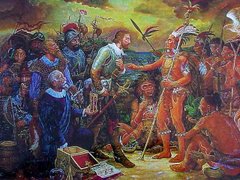
Did You Know: The Taíno were well-renowned for their observance of a culture of peace, yet they did not willingly succumb to Spanish colonization. In fact, not long after Columbus’s arrival, Taino people on the island of Bohio (now Haiti/Dominican Republic) successfully revolted against the first Spanish attempts to conquer their ancient island homeland. This Taino offensive against the Spanish invaders was carried out as early as in 1492 with the destruction of the Fort Navidad following Columbus’ return to Spain. Upon his return to the fort, Columbus learned that the Taino had killed all his men in a swift military operation led by Kaonabo (Caonabo), a chieftain or Kasike of Maguana, an indigenous territory near the center of the island. The rape of Taino women by the Spanish colonizers was among the main reasons the Taino turned to hostility. Kaonabo led a resistance against the Spaniards until he was finally captured in 1494 and imprisoned. Following Kaonabo's imprisonment, his brother Manikateh mounted an unsuccessful attempt to free him and was also imprisoned. According to Spanish sources, Kaonabo is said to have perished at sea while on route to face the Spanish Crown in 1496. - © 2007 UCTP Taino News 

References

Rouse, I. (1992). The Tainos: Rise and Decline of the People Who Greeted Columbus. Yale University Press.

Wilson, S. M. (1990). Hispaniola: Caribbean chiefdoms in the age of Columbus. University of Alabama Press.