Sunday, March 30, 2008

Jamaica and the Taino


Did You Know - The Jamaican national motto is ‘Out of Many One People’, based on the population’s multi-racial roots. This motto is represented on the Coat of Arms, showing a male and female member of the Taino Tribe standing on either side of a shield which bears a red cross with five golden pineapples. The crest shows a Jamaican crocodile mounted on the Royal Helmet of the British Monarchy and mantling. - UCTP Taino News © 2008

Monday, February 11, 2008

Lunar Eclipse Saved Columbus


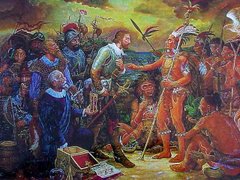
Did You Know - According to Spanish accounts, during Christopher Columbus' fourth and final voyage in 1504, the admiral saved his starving and shipwrecked crew by using an elaborate plan designed to deceive Jamaican Taino into feeding them. Columbus predicted his Christian god would make the moon "inflamed with wrath" and "do evil things to them" if his men were not fed. A lunar eclipse appeared, making his prediction come to pass. Columbus was able to accomplish this rouse thanks to Johannes Regiomontanus, a German scientist who published an almanac that charted solar and lunar eclipses during 1475-1506. Studying the almanac, Columbus learned that a total eclipse of the moon would happen on Feb. 29, 1504. Columbus and his crew were shipwrecked in Jamaica on June 25th 1503. Local Taino initially welcomed him and provided the castaways with food and shelter. However, after being stranded for more than six months, at least half of Columbus’ men mutinied - robbing and murdering several Taino. After this horrific turn of events, the Taino refused to assist Columbus any longer and planned to do away with the crewmen. Seeing his situation as desperate and armed with the knowledge contained in the almanac, he called a meeting with a local Taino kasike (chief) to share an "ominous prediction" before the scheduled eclipse. He announced to the kasike that the Christian god was “angry” because the Taino “were no longer supplying his men with food.” Columbus then stated in “three nights” he would all but obliterate the rising full moon, making it appear "inflamed with wrath;" a signal that “evils” would soon be inflicted upon all the islanders. When the moon turned an "eerie red" as he had "predicted," the reportedly “terrified” Taino brought food to Columbus' men, and allegedly pleaded with him to return it to normal. Columbus announced he would privately confer with his god, and when he returned he said the moon would revert back to its natural state, and it did. The Taino continued to provide supplies for Columbus and his men until they left Jamaica when a relief ship from Hispaniola finally arrived on June 29, 1504. – UCTP Taino News © 2008

Monday, January 28, 2008

Cuba: Hanabanilla


Did You Know - Hanabanilla is a forest reserve located in the central part of Cuba, and it is named after the daughter of a local Taino chief. According to local oral tradition, Hanabanilla means “small basket of gold” in the Cuban Taino dialect. Oral tradition also relates that the young “princess” Hanabanilla was the daughter of a well-respected Kasike (chief) named Arimao and she used the waters of the river that also bears her name as a mirror. The Hanabanilla reserve is located in the Escambray Mountains and is also well-known for its beautiful vegetation, river, water fall, and endemic species such as the Sapo de Hanabanilla. – UCTP Taino News © 2008

Tuesday, December 04, 2007

A Taino Kanei (Caney)


Did you know -
The traditional home of a Taino tribal leader or Kasike is called a kanei (caney); pronounced kah-nehEE. This dwelling was usually a central focal point in the community and faced the iukaieke (village) ceremonial and social grounds called “batei (batey)”. Besides being a residence for the village kasike (chieftain) and family, a kanei was sometimes used a ceremonial gathering place for community leaders including spiritual leaders. Like a typical dwelling called “bohio”, a kanei was traditionally made from local hardwood trees and was usually thatched with the Royal Palm. Unlike a bohio, which was often round, a kanei was typically rectangular, had a gabled roof, and a type of porch. - UCTP Taino News © 2007

Sunday, November 25, 2007

Kanoa is Taino


Did You Know - The first Europeans to travel to the islands of the Caribbean were greatly impressed by the kanoa (canoe) or boats constructed and used daily by the Taino islanders. Christopher Columbus wrote, "On every island there are many canoes of a single piece of wood; and though narrow, yet in length and shape similar to our rowboats, but swifter in movement. They steer only by oars. Some of these boats are large, some small, some of medium size. Yet they row many of the larger row-boats with eighteen cross-benches, with which they cross to all those islands, which are innumerable, and with these feats they perform their trading, and carry on commerce among them. I saw some of these canoes which were carrying seventy and eighty rowers." The kanoa were made from very large trees that were hollowed out over some months. Reminiscent of similar craft in Polynesia, the largest recorded 16th century Taino kanoa were said to hold over 150 people, they were ornately carved, and were used to travel long distances between the Caribbean islands and even into Bahamas, Florida, mainland of South America, Mexico, and Central America. Kanoa - a Taino and Lokono Arawak language term - is still used in Latin American Spanish, and is the origin of the English word canoe. - UCTP Taino News © 2007

Thursday, October 25, 2007

Taino Body Stamps


Did You Know: With hand-crafted clay stamps, Taino people traditionally printed various designs on their bodies or on cotton cloth material. In a process comparable to temporary tattoos or henna-painting, pigments attained from plants such as Bija or Jagua and other natural resources were applied to the Taino stamps. The stamps were then pressed onto the body or cloth, imprinting the beautiful and varied designs. Body stamp designs could represent many concepts. While some designs could have a more traditional meaning among a certain community, others designs could be more of an individual expression. – UCTP Taino News © 2007